
WHY YOUR CHARTER STRATEGY IS YOUR MOST IMPORTANT M&A DECISION
PART 3 OF THE WHITEPAPER
There is a number that should be on every U.S. credit union board agenda right now. Not your current asset size. The one you are growing toward.
$10 billion.
Crossing that threshold triggers a regime change. Institutions above that line become subject to Consumer Financial Protection Bureau examination and lose the small-issuer exemption from debit card interchange fee caps under Regulation II, the Durbin Amendment. Depending on asset size, crossing $10 billion may also trigger reassignment to NCUA's Office of National Examinations and Supervision. Each of those changes carries direct cost and operational implications that compound on top of each other from the moment you cross.
Most boards treat the $10 billion threshold as something that will become relevant later. The institutions that navigate it well start planning years before they get there.
Charter Is a Strategic Variable, Not an Inherited Default
The U.S. dual chartering system gives credit unions a choice that most boards underuse. Roughly 39 percent of U.S. credit unions hold state charters, and state-chartered institutions hold approximately 45 percent of system assets. Charter choice is not static. In 2023, nine state credit unions from seven states converted to federal charters, while two federal charters converted to state.
The argument for revisiting your charter has nothing to do with one being superior. It is about making the choice deliberately, in the context of your M&A goals, rather than inheriting it by default.
The federal charter path gives credit unions a single prudential regulator in NCUA for chartering, examination, and field-of-membership decisions. That consistency across state lines simplifies multi-state operations and the integration of credit unions from different jurisdictions. NCUA’s 2025 modernization of its Consumer Access Process and Reporting Information System has shortened processing times for many field-of-membership amendments, including community charter expansions.
The state charter path offers faster regulatory innovation, more flexible field-of-membership options, and closer working relationships with state regulators. Many states have parity provisions that allow state-chartered credit unions to follow federal field-of-membership rules where those rules provide broader authority. The Wings/Ent merger, one of the two largest combinations of 2025, resulted in a combined institution operating under a Colorado state charter. Scale does not require a federal charter.
The $10 BILLION QUESTION
For boards approaching the threshold, three paths exist. Optimize for staying below it, which means managing growth deliberately and accepting the strategic constraints that come with that. Prepare a multi-year compliance buildout to cross it smoothly, which requires capital planning, governance maturation, and regulatory preparation well in advance. Or use M&A to clear it decisively while integration is already underway, absorbing the regulatory transition as part of a larger transformation rather than as a standalone event.
Each path has different cost, timing, and competitive implications. The worst outcome is drifting across the threshold reactively, without a plan, because organic growth pushed you there faster than expected.
NCUA’s subordinated debt rule, effective January 2022, added a capital tool that did not previously exist for the broader industry. Complex credit unions with total assets above $500 million can now issue subordinated debt that counts toward risk-based capital. For institutions planning acquisitions that will compress capital ratios, this matters. Capital planning and merger planning should be the same workstream, not separate ones.
The Regulatory Environment Now
One further consideration boards cannot ignore. As of mid-2026, the NCUA Board has been operating with reduced membership following the removal of two board members in April 2025. Chairman Hauptman, who was appointed to the Public Company Accounting Oversight Board in January 2026, has indicated he will remain as NCUA Chairman until a successor is confirmed by the Senate. A nominee has been put forward but confirmation is pending. Credit unions developing multi-year strategic plans should track regulatory direction carefully.
What This Means for Your M&A Strategy
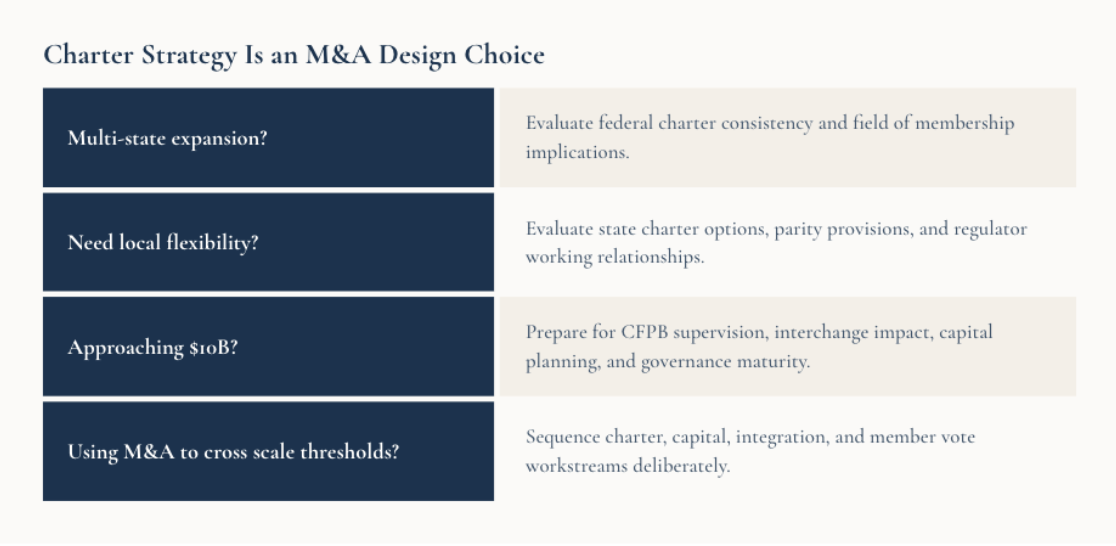
Charter strategy and M&A strategy are the same conversation. The questions boards should be asking: Does our current charter support the geographic expansion we are planning? Are we approaching the $10 billion threshold deliberately or by accident? Have we factored capital planning into our merger timeline? And do we understand what a charter conversion would require if our M&A strategy calls for one?
These are not questions for legal counsel alone. They are board-level strategic decisions that shape every other element of an integration plan.
The full framework, including the Charter Strategy decision table and the four-phase integration model, in the white paper, click on the image below to download.
ABOUT 2OAKS
2Oaks emerged from deep within the banking sector, where our founders personally navigated the challenges of core system modernization. This hands-on experience shaped our unique approach to technology consulting -one that combines technical expertise with practical wisdom. We're not your typical consultancy. As a vendor neutral partner, we work exclusively for our clients' interests across banking, financial services, retail, and public sectors.
What sets us apart is our commitment to co-creation and knowledge transfer. We work alongside your team, ensuring that our solutions aren't just implemented but truly integrated into your organization. Our lean, efficient approach eschews unnecessary complexity in favour of practical, results-driven outcomes. Whether you're facing a system transformation, technology upgrade, or strategic shift, reach out to 2Oaks to discover how our principled, authentic approach can drive your success.