
GOVERNANCE BEFORE ACCELERATION: HOW NORTHERN CREDIT UNION IS BUILDING AI THAT LASTS
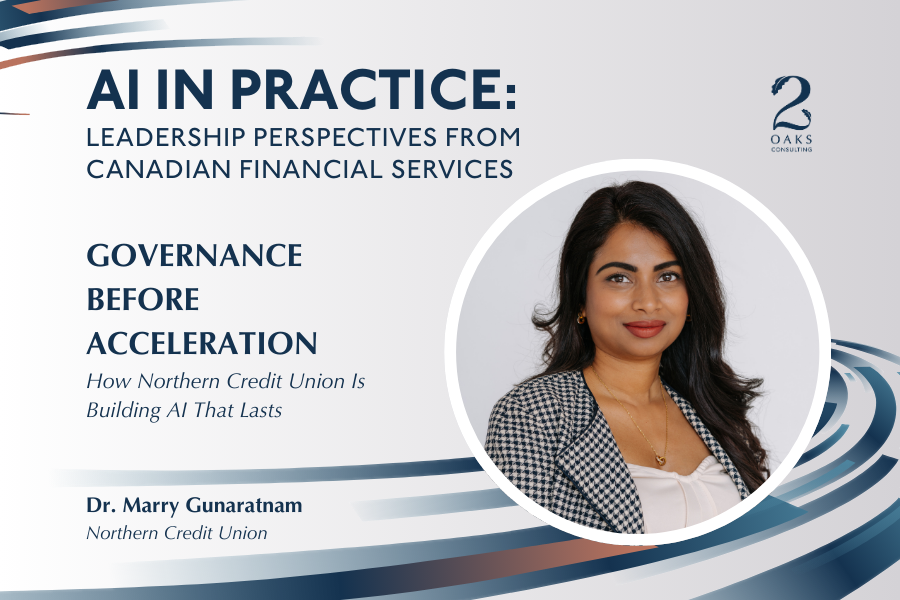
Dr. Marry Gunaratnam explains why moving deliberately on AI requires moving smart.
“If AI innovation scales faster than our guardrails, that’s a recipe for risk. But on the flip side, if we have guardrails and no innovation, that causes us to lose relevance.”
Dr. Marry Gunaratnam, Senior Vice President of IT at Northern Credit Union, articulates the central tension facing every financial institution leader today: how to harness AI's transformative potential without compromising the trust and security that members depend on.
While headlines trumpet the latest AI breakthroughs and competitors rush to announce new implementations, Dr. Gunaratnam is taking a different approach. Northern Credit Union, a $2.4 billion institution serving over 80,000 members across Ontario, is deliberately building foundations before chasing features.
Her approach prioritizes strategic thinking over speed.
The Deliberate Path: Why Governance Comes First
"We are putting governance before acceleration," Dr. Gunaratnam states plainly. This philosophy shapes everything Northern does with AI, from initial exploration to eventual implementation.
The organization is currently conducting a comprehensive AI maturity assessment to establish their baseline capabilities. Only after understanding where they stand will they determine their target state, identify gaps, and decide how quickly to move forward. In parallel, they're building robust data governance frameworks and developing AI acceptable use policies.
This measured approach stands in stark contrast to the AI frenzy dominating the financial services sector. Dr. Gunaratnam references a recent MIT study showing that 95% of AI initiatives fail, primarily because they over-promise and under-deliver. Northern Credit Union is determined not to become another statistic.
"We want to make sure we have the right guardrails in place to ensure responsible AI adoption and that there's proper data stewardship," she explains. The organization is piloting Microsoft Copilot with select individuals in a controlled environment, testing thoroughly before scaling to the broader organization.
“We want to make sure we have the right guardrails in place to ensure responsible AI adoption and that there’s proper data stewardship.”
What makes this approach particularly noteworthy is the employee engagement driving it. "We're fortunate that we have really bright individuals who are frontline. They're seeing the opportunities, they're closest to the problems, and they're pitching solutions." Northern plans to evaluate these employee-proposed initiatives through feasibility studies, selecting the top 3 opportunities that align with resources, investment capacity, and expected return.
From Digital to Intelligent Banking: Redefining Competition
Dr. Gunaratnam's vision extends beyond incremental improvements to existing services. She describes Northern's strategic evolution as moving "from digital to intelligent banking,” a transformation that fundamentally changes how financial institutions serve their members.
"It's the move from reactive banking to anticipatory banking," she explains. Instead of waiting for members to request help, AI enables Northern to proactively surface guidance and recommendations based on member behaviours and patterns, providing support in moments that matter most before members even realize they need it.
This shift becomes more urgent when you understand how Dr. Gunaratnam defines competition. Having previously worked at JP Morgan, she knows the traditional competitive landscape well. But today's reality is fundamentally different.
"Credit unions aren't just competing with the big banks. We're competing with experience, which is coming from fintechs, big techs, even Google, and digital-first non-banks," she observes. Companies like Wealthsimple are setting new expectations for personalization, speed, and convenience. "Our competition is not just the traditional banks. It's all of the other players out there… like non-banks offering bank-like services."
For Northern, the competitive pressure extends beyond who launches AI first. "It needs to feel intuitive from an end user perspective, and it has to be seamless," Dr. Gunaratnam emphasizes. Members don't care about backend technology. They care about experience.
The Reality Check: AI Marketing vs. AI Delivering
Dr. Gunaratnam's pragmatism shines when discussing vendor relationships and the realities of implementation. Her assessment is blunt: "A lot of vendors out there are AI marketing but not AI delivering."
This insight comes from Northern's rigorous evaluation process. When asked about her ideal AI implementation partner, she outlines four requirements: deep understanding of the credit union space, proven domain expertise with actual execution capability, and comprehensive knowledge of financial regulatory requirements, including the differences between OSFI and FSRA oversight. "We need to really see the value there," she states.
Further, Northern isn't interested in AI simply as a checklist item or board presentation talking point. "Don't just treat AI as a tool or a checklist project. Look for capabilities…so we can deliver value.”
This practical perspective extends to data quality, which Dr. Gunaratnam identifies as one of most financial institutions’ primary readiness gaps. "Garbage in, garbage out is so relevant as it relates to AI," she notes, explaining that AI systems require enormous amounts of quality data, algorithms, and compute power to produce reliable results.
Northern is addressing this through comprehensive data classification models that identify and tag confidential, sensitive, and personally identifiable information. This ensures that even when AI is used for learning, member data remains protected. "We're ensuring control-based permissions so people have the right level of access and it's not more permissive than it needs to be."
“Security by default... privacy by design.”
The organization's security philosophy is foundational: "Security by default... privacy by design." Dr. Gunaratnam emphasizes that "we are carrying out AI the way we do cybersecurity. It needs to be secure before it becomes scalable."
AI Plus Human: Rethinking the Workforce
One of the most thoughtful aspects of Northern's AI strategy is how the organization addresses workforce concerns. Employees have approached Dr. Gunaratnam to ask what AI means for their jobs, particularly for those in back-office roles who have spent years managing manual processes and mountains of paperwork.
Her response reframes the question entirely. For a credit union built on trust and relationships, full automation isn't the goal in the near future. "It's about allowing our people to do more higher-value tasks. It was never a question of ‘Is it going to be AI or is it going to be human?’ It's a combination of the two.”
In other words, the workforce is evolving, not disappearing. "We don't have typewriters anymore. Roles are going to evolve. There are going to be areas where we need to scale up," Dr. Gunaratnam acknowledges. The competitive advantage will belong to "people who really understand the space and how it fits within their context" rather than those resistant to change.
This philosophy requires investment in AI literacy across the organization. Northern is creating an AI webinar page on their intranet to educate staff about risks and promote responsible adoption practices. The goal is to prevent "shadow AI", uncontrolled AI usage across the organization that Dr. Gunaratnam notes "is probably, if not already, very much relevant."
"It really starts with building AI literacy and ensuring our staff are adequately equipped to deal with AI and understand AI," she explains. Employees are being taught not to blindly accept AI outputs as truth, especially when decisions impact members or support key business processes, and never to feed confidential information into AI systems.
Building for Scale: Practical Implementation Strategy
Dr. Gunaratnam's vision for immediate AI impact is remarkably specific: "An enterprise-grade AI copilot for all employees, one that would automatically fully integrate across all of our core banking platforms, collaboration tools, and knowledge repositories."
She identifies information friction as Northern's greatest efficiency loss; thus, when it comes to an AI solution, "the real challenge is it needs to be secure, needs to be able to seamlessly integrate across all of our systems and really surface insights."
Beyond this foundational capability, Northern is exploring several high-value use cases:
Hyper-personalization using AI to understand member needs and dynamically adapt their journey, providing proactive guidance rather than waiting for requests.
Real-time fraud detection with autonomous threat response. Dr. Gunaratnam recently attended a session showcasing AI systems that "can detect threats before they even materialize into a threat", moving from reactive identification to anticipatory containment.
Credit adjudication and underwriting with AI intelligence providing 720-degree member views and predictive risk scoring to support better, faster lending decisions.
Looking ahead two to three years, Dr. Gunaratnam expects AI-assisted member services, intelligent credit decisioning, and back-office automation to become table stakes in financial services. Organizations that build these capabilities now will compete effectively; those that wait will struggle to catch up.
The Path Forward: Advice for Fellow Leaders
When asked what advice she would give other technology leaders beginning their AI journey, Dr. Gunaratnam returns to her core philosophy: "Start with governance and clarity of purpose.
“Start with governance and clarity of purpose”
She emphasizes building momentum through small pilots, then scaling responsibly when results prove valuable. "Earn that trust," she advises, noting that there's tremendous value in incorporating AI into strategy early while simultaneously scaling up employee AI literacy.
Northern's approach requires patience and discipline. "We're a little bit behind, but we need to make sure we're building the foundations before we scale," Dr. Gunaratnam acknowledges. She expects an exponential learning curve once those foundations are properly established.
"The culture and the data stewardship are really the long-term differentiators," she observes. Technical foundations can mature quickly, but organizational readiness and trust take time to develop properly.
When asked about what resources would most help Northern move faster, Dr. Gunaratnam identifies accelerators or sandboxes: controlled environments where organizations can test AI capabilities with proper guardrails while mimicking real integration complexities. This would enable proof-of-concept validation before committing to full-scale implementation.
The Balanced Future
Dr. Gunaratnam recently participated in a panel featuring credit unions of varying sizes, all at dramatically different stages of AI adoption. Some have adopted AI heavily, some remain resistant, and some (like Northern) are exploring with clear intent, putting guardrails in place before scaling.
This diversity of approaches reflects the industry's broader uncertainty. Many use the term "AI," but few share the same understanding of what it actually means or how to implement it effectively.
Northern Credit Union's deliberate approach offers a roadmap for organizations seeking to navigate this complexity: prioritize governance over acceleration, build data-quality foundations, invest in AI literacy, and maintain a focus on member value over technology trends. This is how Northern is positioning itself for sustainable AI adoption rather than spectacular failure.
The key is finding the right balance between innovation and security. "Both have to happen in lockstep. We have to be able to innovate, but on a layer of security," Dr. Gunaratnam summarizes. Organizations that master this balance (i.e. moving fast enough to remain competitive while moving carefully enough to maintain trust) will define the future of intelligent banking.
Innovation without guardrails is indeed a recipe for risk. But guardrails without innovation lead to irrelevance. Northern Credit Union, under Dr. Gunaratnam's leadership, is charting the course between these extremes.
Key Takeaways for Technology Leaders
(Summarized by AI)
Before Implementation:
Conduct comprehensive AI maturity assessments to understand your baseline
Build data governance frameworks in parallel with AI exploration
Develop clear AI acceptable use policies and educate employees
Start with controlled pilots before scaling to production
During Implementation:
Prioritize governance alongside innovation (neither can wait for the other)
Focus on capabilities that solve real problems, not technology for its own sake
Maintain human oversight even as systems become more autonomous
Build AI literacy across the organization, not just technical teams
For Long-term Success:
Invest in data quality as a foundational requirement
View AI as enabling "AI plus human," not replacing human judgment
Measure success by member value created, not technology deployed
Partner with vendors who deliver AI, not just market it
Dr. Marry Gunaratnam PD, EMBA, P.Eng, PMP serves as Senior Vice President of IT at Northern Credit Union, where she leads technology strategy and innovation initiatives. Prior to joining Northern, she held senior technology roles at JPMorgan Chase. She was recently recognized at the House of Lords and UK Parliament for her contributions to the technology sector.
This interview is part of 2Oaks' CIO Spotlight Series, featuring technology leaders sharing practical insights on implementing AI in financial services. To learn more about how 2Oaks helps financial institutions navigate AI implementation, visit www.2Oaks.ca.