
BUILDING AI THAT WORKS: HOW LIBRO CREDIT UNION IS LEARNING TO SEPARATE HYPE FROM REALITY
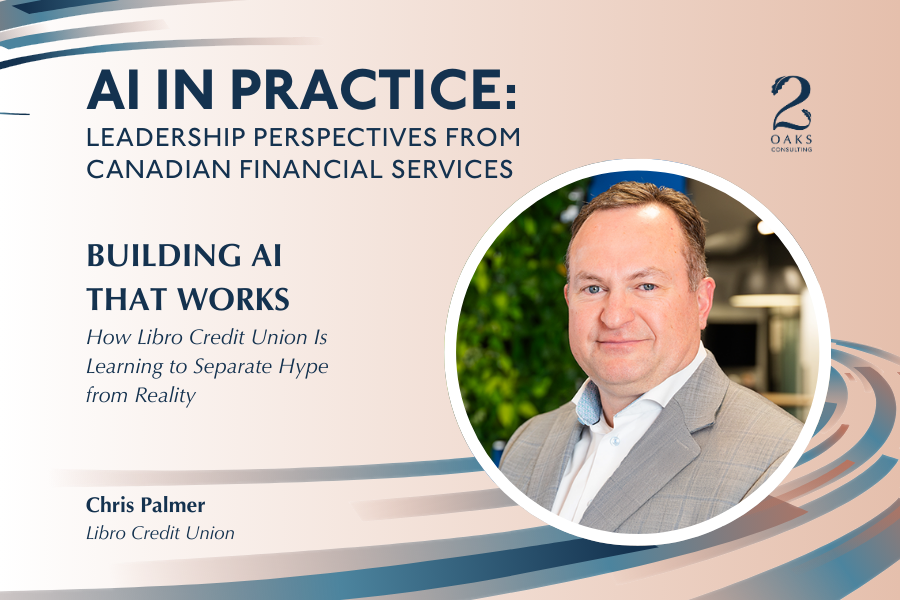
Chris Palmer shares a candid view from the front lines of AI implementation, where data preparation matters more than marketing promises.
“Is your AI guessing?”
This question was posed to Chris Palmer, Chief Information & Technology Officer at Libro Credit Union, at a recent Finovate conference in New York, and it captures a core challenge facing today’s financial institutions.
Without quality data, AI systems don't analyze or recommend. They guess. And guessing erodes the organizational confidence needed for successful AI adoption.
While AI dominates many technology conversations and boardroom agendas, most projects fail to deliver meaningful results. MIT’s The GenAI Divide: State of AI in Business 2025 found that 95 percent of enterprise AI pilots fail to show measurable business impact or ROI. These projects often rely on generic tools that look impressive in demos but prove ineffective in real-world workflows.
Chris has seen and heard firsthand this pattern of “lukewarm results when it comes to AI initiatives,” and the reason for failure is often “because the right data wasn’t in place to feed the AI.”
Chris is determined that Libro’s AI journey will be different. Since joining Libro in 2024, he has guided the credit union through its early AI journey with a growing understanding of both the technology's potential and its pitfalls. As he explains below, Chris’s approach prioritizes learning over rushing, data quality over flashy features, and augmentation over automation.
The Early Journey: Finding Wins Amid Mixed Results
"We're just starting on the journey to a large part," Chris explains. Libro has implemented Microsoft Copilot across most of the organization as its initial foray into AI at the staff level. The results have been instructive.
"Right now, things like our procedures and policies aren't actually where Copilot can see them," Chris notes. "So from a knowledge base perspective, it hasn't been a huge success yet." The integration with Microsoft Teams has delivered time savings, but the bigger opportunity remains untapped.
This honest assessment reveals an important aspect of AI implementation: the technology itself works, but the challenge lies in preparing the organization to use it effectively.
Adoption patterns have surprised Chris. "The executive team has used it more than I expected, getting Copilot to build them documents." Further, creative applications are emerging from unexpected places, such as finance, where Copilot was used to write a macro to help create FISRA reporting.
"It's almost on a per person basis," Chris observes. "Some people have more interest than others in trying things."
“Bringing business intelligence and the We’re crafting the governance side this year, asking what our AI strategy is going to look like and what guardrails we’re putting around it.”
This individual experimentation is valuable, but Libro recognizes the need for structure. The organization is currently shaping governance frameworks and defining its AI strategy. "We're crafting the governance side this year, asking what our AI strategy is going to look like and what guardrails we're putting around it."
Once that foundation is set, Libro will move into a feasibility study phase, evaluating employee-proposed initiatives and building a prioritized backlog for 2026.
The Data Imperative: Why AI Without Quality Data Is Just Guessing
Chris returns repeatedly to one fundamental truth: "The benefits and best outcomes of these types of initiatives come from the data you give the AI tools."
This isn't a theoretical concern. Organizations that skip data preparation are now discovering their AI systems produce unreliable outputs.
"We don't want AI guessing," Chris emphasizes, "because it will…if it doesn't have the right data, and that taints the confidence rate of the organization and the user."
This is why Libro's first major AI use case will likely be a robust knowledge base. The operations team has been pushing for this capability, recognizing how user expectations are shifting.
"People used to Google and put in keywords to get stuff back," Chris explains. "That expectation is changing… Now we ask questions about how to do something." Instead of searching for a document to read, Libro wants members to be able to ask their system, "How do I do a foreign exchange transaction?" and have the steps appear immediately.
This shift from keyword search to conversational query represents more than a user interface change. It fundamentally alters how organizations must structure and maintain their knowledge systems.
Board Pressure and Evolving Expectations
The urgency around AI strategy does not only come from end-user expectations. It also comes from board expectations. "When I started a year ago, the board wanted us to ‘do something’ with AI," Chris recalls. "Now there's pressure to have an articulated plan around AI and how we'll use it."
This evolution from vague enthusiasm to demanding concrete strategy mirrors the industry's broader maturation. Boards recognize AI's importance but increasingly want to understand the roadmap, the governance, and the expected outcomes.
Fraud Detection: Where AI Meets Urgent Need
At Finovate, Chris noticed "many of the fintechs were pitching AI-based fraud detection, fraud elimination, or reduction tools." This isn't surprising given the escalating sophistication of fraud.
"We think about digital onboarding and how much KYC systems are based on IDs and how easy it is now to use AI to fake those IDs very well," Chris observes. As fraudsters weaponize AI to create convincing fake identification, financial institutions must deploy AI defensively. "We use AI to fight the evil side of what you can generate with AI."
“We use AI to fight the evil side of what you can generate with AI.”
For Libro, fraud investigation represents a clear opportunity. "It takes about 6 1/2 hours on average to investigate one suspicious transaction," Chris explains. "So it's low-hanging fruit" for AI-driven efficiency gains that don't add value to the organization in their current manual form.
The Future of Digital Banking: From Transactions to Conversations
Chris also sees conversational AI fundamentally reshaping digital banking, “putting the ability to have conversation… inside the digital banking space." He explains that a chat someone can talk to, or one that handles their transactions, represents "a big shift in how people will interact with their online banking solutions."
The vision is compelling: natural conversation instead of navigating menus or remembering where functions live. "Transfer money here… pay 200 dollars on my visa…" and more.
Chris predicts how "user expectations are going to change on how they want to interact with digital banking.” This isn't a distant future. It's happening now, and credit unions need to prepare.
Looking further ahead, Chris raises another interesting question: machine-to-machine interactions. What happens when a member's personal AI agent needs to interact with the credit union's AI systems? "How do we differentiate? How do we create that member experience that's so important to how we work?" These questions don't yet have answers, but Libro is considering them now.
Augmentation, Not Automation: Rethinking AI’s Role
Chris recently encountered an insight that reshaped his thinking about AI implementation. "With AI, we should think more about augmentation than automation," he explains. "Don't try to automate roles in your organization. Try to think about how you can augment them so they're four or eight times faster."
This represents a significant philosophical shift. "As technologists, we tend to look to automate things. We see a new technology and think we can use that to automate." But AI works differently. "AI is best as an augmentation where you still keep a human in the loop; you just make them a whole lot faster."
This approach addresses employee anxiety while capturing the benefits of AI. Rather than eliminating roles, AI removes friction and tedious tasks, allowing people to focus on higher-value work.
“There’s a lot of manual work that happens, a lot of ‘check the checker’ kind of things that go on, and we could certainly aim AI agents to do that work more efficiently… when the rest of us are sleeping.”
For commercial lending, Chris sees further significant opportunity. "Those processes are very long, and much of it is data gathering processes." AI agents could collect required information from applicants, process documentation, and correctly populate applications, dramatically shrinking cycle times while maintaining human oversight of decisions.
The Vendor Challenge: Marketing vs. Delivering
Chris has a frank assessment of the vendor landscape. "There's an oversell of AI right now," he states. The challenge for financial institutions is "who's actually using AI in the right way that you can benefit from, and who's just marketing it to you? It's a huge differentiator… People say AI, but when you start talking about it, it's really just an algorithm."
This creates a buyer-beware environment where due diligence is essential. Chris looks for partners who are "transparent and ethical." Organizations need vendors who will honestly assess whether their AI solutions can deliver value for the specific use case, not just vendors eager to make a sale.
"For financial institutions our size, we also need to leverage vendors…to let us know what's happening, what the possibilities are, and what opportunities are out there." The right partners become educators and guides rather than just technology providers.
Security and Privacy: Amplified Importance
When it comes to security, AI doesn't eliminate existing concerns. It magnifies them. "The controls you have today around your data, your documents, and everything else become amplified with AI," Chris explains.
The challenge extends beyond organizational controls to individual behaviour. "There is some individual onus and responsibility here, too. That's going to require some training."
Chris has heard and witnessed cautionary tales, such as people putting passwords in documents that Copilot then found. Another organization discovered employees could search for colleague salaries because the AI had access to that data.
Libro is moving toward a zero-trust security model, recognizing that AI makes proper access controls more critical than ever.
The Education Gap: From Fear to Silver Bullet Thinking
Chris identifies organizational education as a key readiness gap. "We have to do a better job of education around the possibilities."
The challenge spans both ends of the spectrum:
“There are some people who don’t know much about AI and are leery or scared to embrace it. And then you have the other side of the spectrum where people think it’s going to be the silver bullet to everything.”
The goal is to bring both groups toward a realistic understanding. "You have to get the art of the possible understood across the organization."
This education challenge has practical implications. Libro engaged a partner for Copilot training, which went reasonably well but taught valuable lessons. The training included using AI for social media content, which is specifically forbidden by Libro's employee code of conduct.
If Chris could redo that training, he would "help the partner a little bit more on the scoping or the positioning of those elements to make sure that they're just showing you how to do it, not encouraging every staff person in the organization to become a corporate social media person."
Lessons Learned: Starting the Journey
Chris's advice to other technology leaders reflects his hard-won experience. "We could have gotten more of our actual documents where they needed to be for Copilot to see them. I think that was a big gap for us. So simply preparing your data in whatever format it is for the consumption of AI is big."
Data preparation isn't glamorous work, but it goes a long way toward determining whether AI initiatives succeed or join the 95% that fail to deliver ROI.
Chris also emphasizes the importance of building confidence. Starting with simpler, winnable projects establishes organizational trust. "That's why we're looking at a knowledge base project to start, where we know we can get all the data together correctly and have a real win to build confidence in the organization."
Success breeds confidence. Confidence enables broader adoption. Broader adoption creates organizational capability.
Looking Ahead: Table Stakes and Transformation
Chris expects several AI applications to become table stakes within two to three years. Fraud detection tops the list, followed by AI-assisted credit adjudication. "We certainly don't have automated decisioning on our retail book in a sophisticated way," Chris notes. "That's another area that will become table stakes soon."
What interests Chris most is how AI might fundamentally change adjudication. "What will it look for differently? Maybe there are things that from a human's perspective take too long to find." AI could reveal insights humans consistently miss due to time constraints or cognitive limitations.
For Libro, the path forward balances ambition with pragmatism.
“Keep the expectations realistic. There is a real potential here for AI, but having the right data to feed the AI is so important.”
Without quality data, "the odds of hitting your objectives are fairly low."
The Reality Beyond The Hype
Chris's perspective cuts through AI hype with wisdom garnered from actual implementation. His message is neither pessimistic nor mindlessly optimistic. AI offers genuine value, but only for organizations willing to do the unglamorous work of data preparation, governance development, and realistic expectation setting.
The credit unions and financial institutions that succeed with AI won't be those that move fastest. They will be those who move most thoughtfully, ensuring their AI augments human capability rather than guessing its way to unreliable outputs.
As Chris reminds us: "We don't want AI guessing." The difference between AI that works and AI that disappoints comes down to the quality of data you feed it and the clarity of problems you ask it to solve.
For organizations still wondering how to approach AI, Chris's journey at Libro is insightful. Start with clear use cases where data can be adequately prepared. Build organizational confidence through early wins. Invest in education that manages both fear and over-enthusiasm. Choose partners who deliver rather than just market. And remember that AI's most significant value lies in making humans more capable, not in replacing them.
The 95% failure rate exists for a reason, but Chris Palmer and Libro Credit Union are taking the proper steps to join the 5% that succeed.
Key Takeaways for Technology Leaders
(Summarized by AI)
Before Implementation:
Prepare your data before implementing AI tools
Set realistic expectations across the organization
Define governance frameworks and guardrails
Identify clear, winnable first use cases
During Implementation:
Think augmentation rather than automation
Keep humans in the loop for confidence building
Ensure training scope aligns with organizational roles
Monitor for unintended data exposure risks
For Long-term Success:
Educate across the organization on realistic possibilities
Evaluate vendors on delivery, not marketing
Build on early wins to create organizational momentum
Remember: AI that guesses is AI that fails
Chris Palmer serves as Chief Information & Technology Officer at Libro Credit Union. With over 25 years of experience in financial services technology, including founding Neocog Technologies and serving as Senior VP of Product Vision and Strategy at Doxim, he also teaches as a Professor of Information Technology at Fanshawe College. He holds bachelor's degrees in Music Performance and Computer Science and an MBA from the Richard Ivey School of Business at Western University.
This interview is part of 2Oaks' CIO Spotlight Series, featuring technology leaders sharing personal and practical insights on implementing AI in financial services. To learn more about how 2Oaks helps financial institutions navigate AI implementation, visit www.2Oaks.ca.