
MAKING THE RIGHT CHOICE
PERHAPS YOU’RE FAMILIAR WITH THESE SCENARIOS:
Scenario 1: A review of a mid-sized financial institution's IT operations reveals a fragmented technology landscape, with core banking managed internally while multiple vendors handle digital platforms. The fragmentation manifests in slow mobile updates, inconsistent online banking, and poor integration between backend and wealth management systems.
Scenario 2: A major retailer faces a point-of-sale system failure during the holiday rush that left stores unable to process transactions, costing both revenue and customer loyalty. Or perhaps an inventory management system crash has prevented online order processing, or a website collapse paralyzes operations.
When technology failures occur, leadership must rethink their IT resourcing strategy. However, the solution isn't a simple choice between insourcing or outsourcing—it requires careful evaluation of which functions need to stay in-house, and which can be managed by external partners. The right IT approach can mean the difference between agile growth and costly inefficiencies, making it crucial to understand the strengths and limitations of each option.
THE POWER OF INSOURCING
BUILDING AN INTERNAL IT TEAM OFFERS DISTINCT ADVANTAGES THAT MANY ORGANIZATIONS FIND INVALUABLE.
The key benefits include:
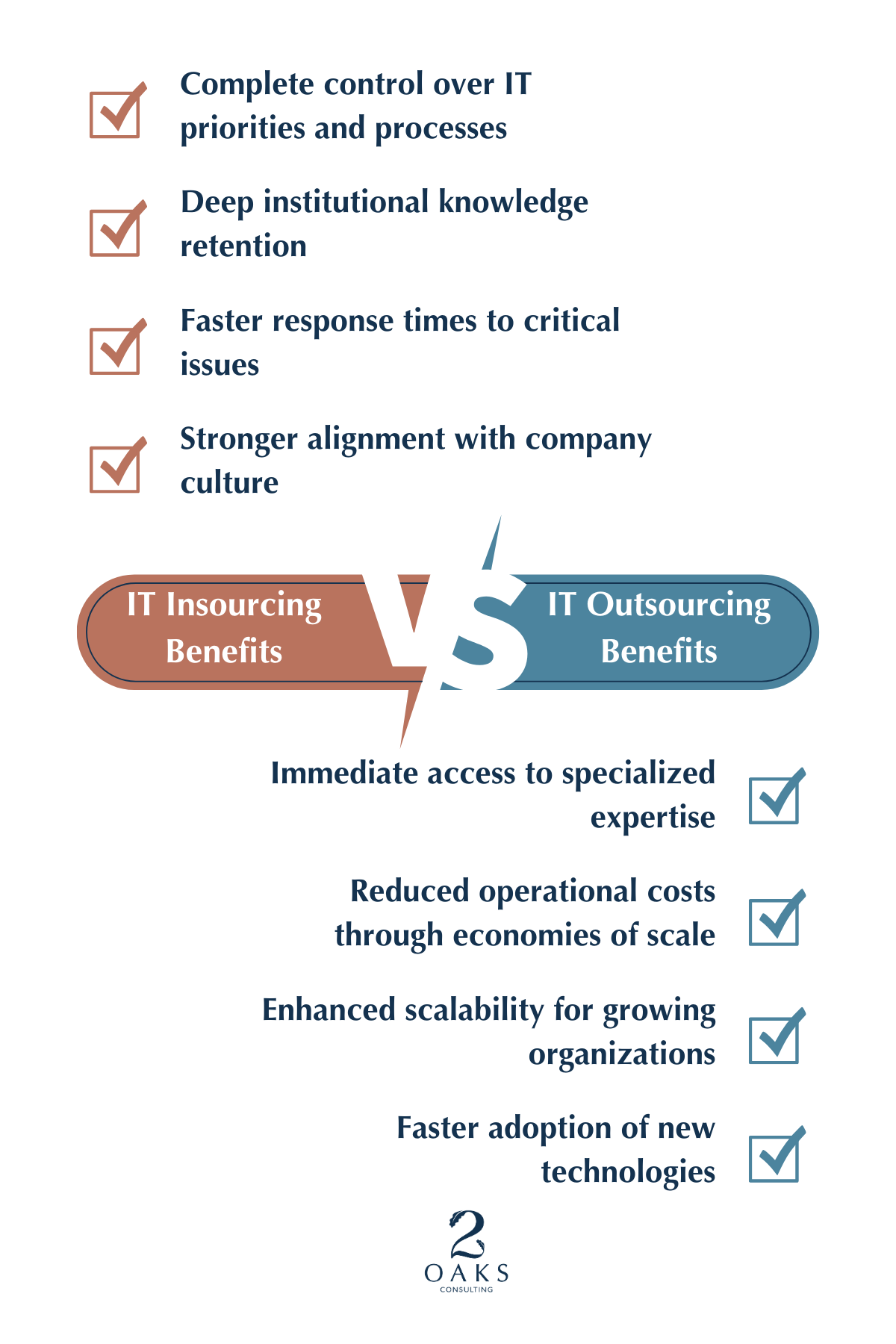
Complete control over IT priorities and processes: Your organization can quickly shift priorities, implement changes, and adapt systems without navigating third-party agreements or change requests.
Deep institutional knowledge retention: Internal teams develop an intimate understanding of your business processes, systems history, and unique technical challenges that compounds in value over time.
Faster response times to critical issues: When problems arise, internal teams can immediately assess and address them without the delays inherent in vendor communication and service level agreements.
Stronger alignment with company culture: In-house IT staff become integral members of your organization, sharing your values and understanding the broader business context of technical decisions.
However, the path of insourcing comes with significant considerations. Organizations must be prepared for substantial upfront investments in recruitment and training. Many companies struggle to maintain cutting-edge expertise across all required technology domains, particularly as technology landscapes evolve rapidly. Scalability can also become a challenge, especially during periods of rapid growth or when specialized skills are suddenly needed.
THE OUTSOURCING ADVANTAGE
OUTSOURCING HAS EMERGED AS A POWERFUL ALTERNATIVE, PARTICULARLY AS TECHNOLOGY BECOMES INCREASINGLY COMPLEX AND SPECIALIZED
The key benefits include:
Immediate access to specialized expertise: External providers maintain teams of specialists across various technology domains, offering expertise that would be costly to develop internally.
Reduced operational costs through economies of scale: Service providers can distribute overhead costs across multiple clients, often resulting in lower per-unit costs for standard IT services.
Enhanced scalability for growing organizations: External providers can quickly allocate additional resources during growth periods or special projects without the lengthy process of hiring and training new staff.
Faster adoption of new technologies: Service providers typically invest heavily in emerging technologies and can implement new solutions more quickly than internal teams building from scratch.
Yet outsourcing isn't without its challenges. Organizations must carefully manage the potential loss of direct control over IT processes and navigate possible communication barriers. Data security concerns and dependency on third-party performance require robust governance frameworks and clear service level agreements.
CREATING YOUR STRATEGIC FRAMEWORK
A SUCCESSFUL IT RESOURCING STRATEGY REQUIRES A METHODICAL APPROACH THAT BALANCES BUSINESS NEEDS WITH OPERATIONAL CAPABILITIES
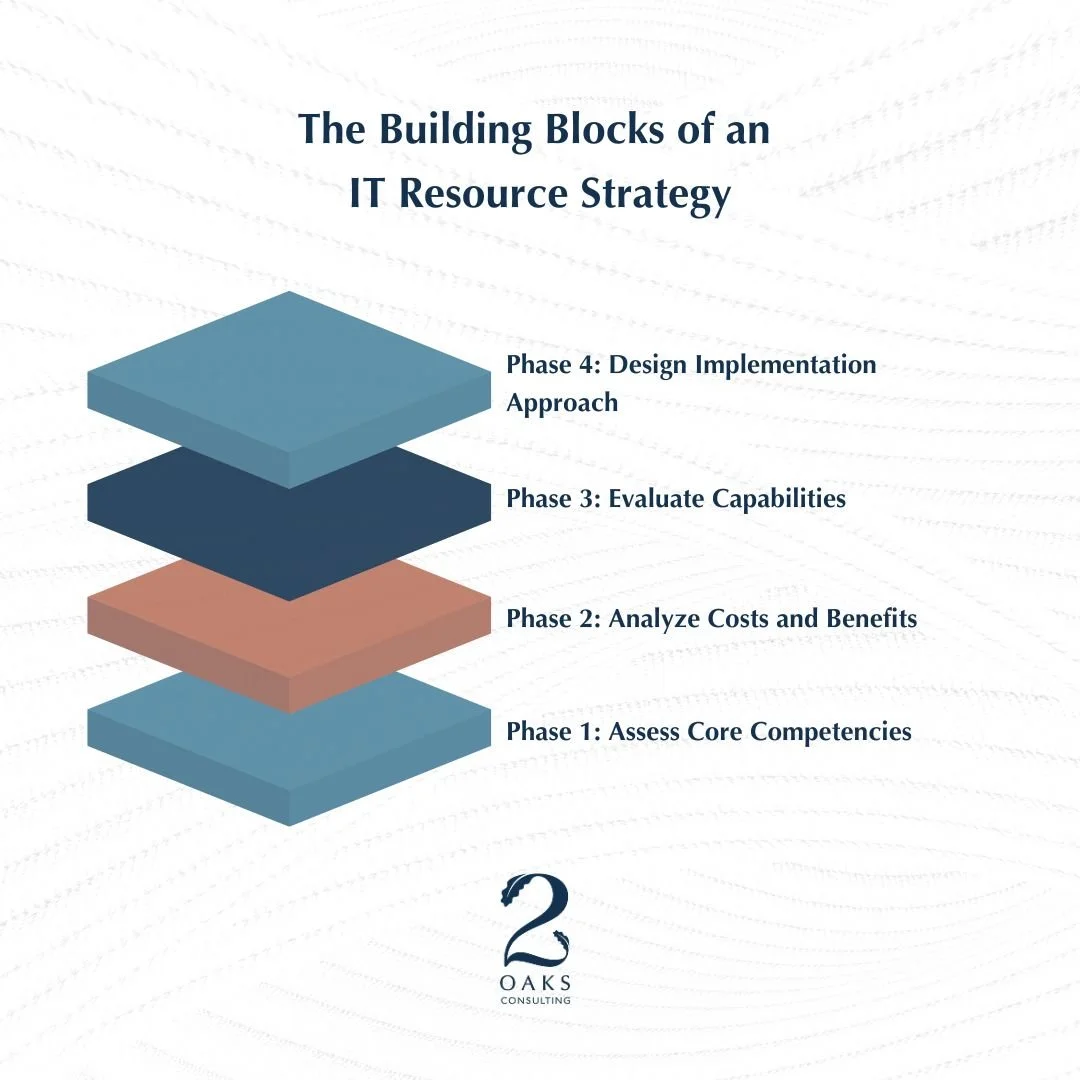
Follow these four key phases to ensure a comprehensive assessment and well-planned implementation:
Phase 1: Assess Core Competencies. Assess your IT landscape by evaluating core business functions through strategic value, operational criticality, and enhancement potential. This analysis determines which functions should remain in-house versus outsourced for optimal efficiency.
Phase 2: Analyze Costs and Benefits. Evaluate both direct costs and broader financial implications when comparing in-house versus vendor options, including risk management and scalability factors. The analysis must weigh total costs, compliance requirements, and long-term flexibility needs. Comparing vendor quotes against payroll expenses is not enough.
Phase 3: Evaluate Capabilities. Evaluate internal capabilities and market options across three dimensions: current resources, vendor landscape, and future needs. This assessment determines the optimal balance between internal development and external support.
Phase 4: Design Implementation Approach. Create an implementation strategy that balances control with flexibility by defining internal and external responsibilities while maintaining operational agility. Focus on resource allocation, governance structure, and integration planning to ensure smooth transitions and adaptability.
These four phases will create a robust framework for all your IT resourcing decisions
CONCLUSION: DO YOU NEED AN IT OVERHAUL?
WONDERING IF YOUR ORGANIZATION NEEDS AN IT TRANSFORMATION?
Consider these essential questions:
Strategic Alignment: How well do your current IT capabilities support your business objectives, and what gaps need to be addressed?
Resource Optimization: Are you making the most effective use of your current IT investments, both in terms of human capital and technology infrastructure?
Risk and Readiness: What potential challenges or resistance might you face during a transition, and how prepared are you to address them?
Your organization is unique, and you must find the right balance between insourcing and outsourcing for your IT needs. 2Oaks can help you choose the best option and navigate this complex transformation. We’ve helped organizations across banking, financial services, and retail sectors optimize their IT resourcing strategies, and will work alongside your team to co-create an IT resourcing strategy that accelerates your journey to success.
Contact 2Oaks today to leverage our expertise in crafting and implementing optimized IT strategies. Our comprehensive guidance will help you navigate the path to a more efficient, resilient, and competitive IT operation
DOWNLOAD THE PDF DOCUMENT BELOW:
ABOUT 2OAKS
2Oaks emerged from deep within the banking sector, where our founders personally navigated the challenges of core system modernization. This hands-on experience shaped our unique approach to technology consulting—one that combines technical expertise with practical wisdom. We're not your typical consultancy. As a vendor-neutral partner, we work exclusively for our clients' interests across banking, financial services, retail, and public sectors.
What sets us apart is our commitment to co-creation and knowledge transfer. We work alongside your team, ensuring that our solutions aren't just implemented but truly integrated into your organization. Our lean, efficient approach eschews unnecessary complexity in favour of practical, results-driven outcomes. Whether you're facing a system transformation, technology upgrade, or strategic shift, reach out to 2Oaks to discover how our principled, authentic approach can drive your success.