
THE TECHNOLOGY DEAL INSIDE THE FINANCIAL DEAL: How Credit Unions and Banks Can Protect M&A Value from Letter of Intent to Benefit Harvesting
WHITE PAPER
North American financial institutions are consolidating in response to rising regulatory expectations, increasing technology investment requirements, cybersecurity and operational resilience demands, talent scarcity, and the steady escalation of member and customer expectations. In both the United States and Canada, the number of credit unions has declined materially over time while system assets and member relationships have continued to grow. Fewer institutions are carrying larger balance sheets, broader service expectations, and more complex technology estates.
For boards and executives, the strategic rationale for M&A is increasingly clear. Scale can help fund modernization, expand geographic reach, diversify revenue, attract specialist talent, and strengthen resilience. Scale alone does not create value. Value comes when the combined institution can integrate platforms, migrate and reconcile data, protect service continuity, rationalize vendors, maintain control integrity, and capture the benefits assumed in the deal case.
This is why technology has moved from a post-signing implementation workstream to a front-end deal consideration. Foundational elements (core banking, data architecture, lending platforms), security and resilience (cybersecurity, IAM, business continuity), and customer-facing channels (digital, payments) now directly influence deal feasibility, valuation, and regulatory confidence. Furthermore, operational factors like vendor contracts and reporting dictate execution risk and synergy realization.
This paper builds on 2Oaks Consulting’s Canadian and U.S. credit union M&A research by examining the technology deal inside the financial deal. It provides a practical lifecycle view from strategic intent and letter of intent through deal creation, valuation, diligence, planning, execution, stabilization, and benefit harvesting. It is designed for credit union and bank boards, CEOs, CIOs, COOs, CFOs, integration leaders, and deal teams that want to understand how technology risk and technology opportunity should shape M&A decisions before value is either protected or lost.
Three Things Leaders Should Know
1. The technology estate affects deal value before close. Core platforms, data quality, vendor contracts, cyber posture, and integration complexity should influence valuation and deal structure.
2. The integration clock starts before the announcement. Late technology discovery creates delays, cost overruns, member or customer disruption, and missed synergy targets.
3. Benefit harvesting depends on disciplined platform decisions. Synergies do not appear because the deal closes. They are captured through sequencing, governance, execution discipline, and post-conversion optimization.
Why This Paper, and Why Now
The consolidation of credit unions and community financial institutions has become a structural feature of the market rather than an occasional event. In the United States, federally insured credit unions continue to decline in number even as assets, loans, and membership grow. In Canada, the number of credit unions and caisses populaires has fallen over many years on a similar path. In both markets, fewer institutions are serving larger member and customer bases, managing more sophisticated balance sheets, and carrying heavier operating, regulatory, and technology obligations.
The scale of that shift is documented in both markets. In the United States, the number of federally insured credit unions fell to 4,250 by the first quarter of 2026, down from 4,411 a year earlier, even as system assets rose to $2.48 trillion and membership reached 145.8 million.1 In Canada, the system has contracted from more than 500 credit unions and caisses populaires in 2005 to fewer than 400 by January 2026, serving over 11 million members, roughly 27 percent of the population.2
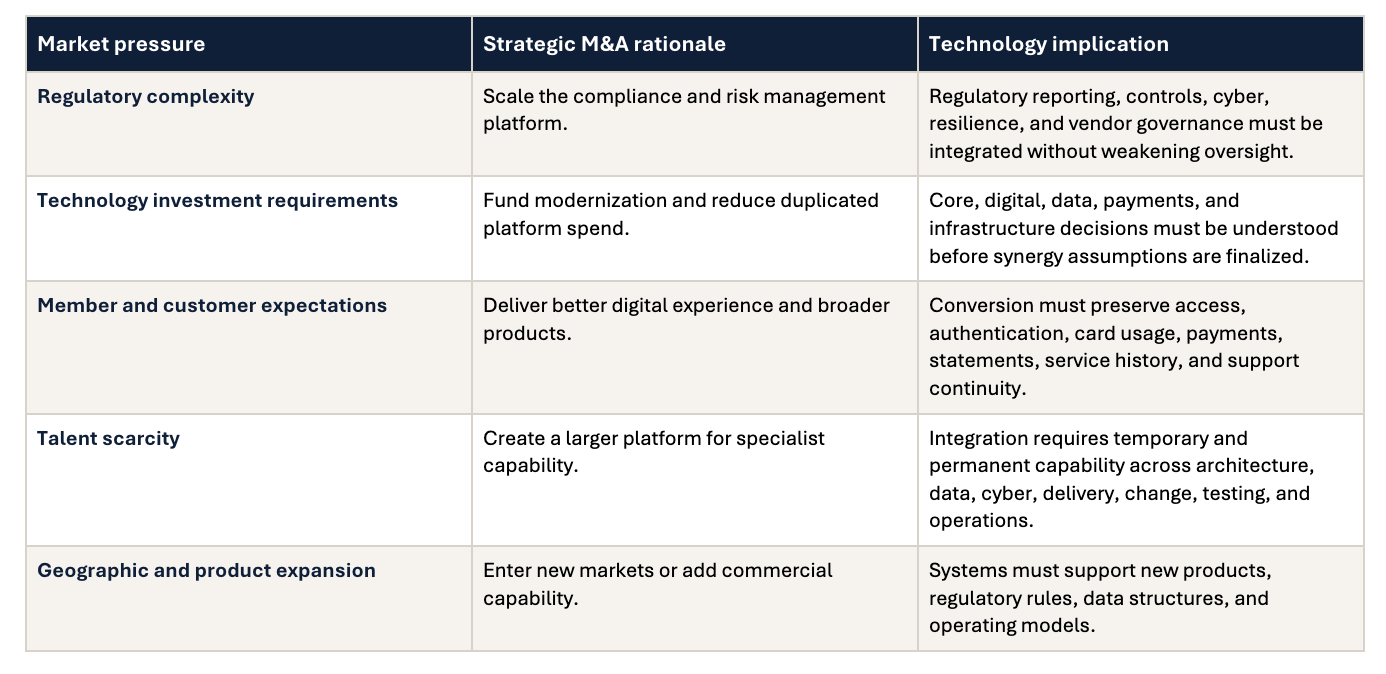
The prior 2Oaks M&A white papers set out the consolidation imperative for Canadian and U.S. credit unions. They identified the major forces behind consolidation, including regulatory complexity, technology investment requirements, member expectation evolution, talent scarcity, and geographic or demographic shifts. Those forces do not merely create pressure to merge. They change the standard for what a successful merger must achieve.3
Technology is central to that standard. Modern financial institutions need resilient core platforms, integrated digital channels, secure data environments, real-time payments capability, strong vendor governance, and increasingly sophisticated analytics and automation. These capabilities are expensive to build and sustain. They are also difficult to integrate after a transaction if they were not considered before the transaction was priced, approved, and communicated.
The economics of that modernization are concentrated in a small set of providers. The U.S. core banking market is dominated by a handful of vendors, and core processing is a major recurring revenue line for them: core-related products accounted for roughly 11 to 12 percent of Fiserv revenue and about 31 percent of Jack Henry revenue in fiscal 2025.4 Migrating between these platforms, or onto cloud-native cores, is among the most expensive and highest-risk programs a financial institution can undertake.5
That gives technology a double role in M&A. First, it is often part of the reason institutions seek scale in the first place. Second, it determines whether the combination can actually produce the value that scale promises.
Scene Setter
The Canadian and U.S. M&A papers address why consolidation is happening. This paper addresses what determines whether it succeeds: the technology and operational work that turns a closed deal into a functioning institution.
The full 21-page white paper can be downloaded here.
From Market Consolidation to Technology Execution
2. The Technology Deal Inside the Financial Deal
Every financial institution M&A transaction has two deals running in parallel. The first is the visible deal: strategy, governance, valuation, legal structure, regulatory approval, communication, and closing mechanics. The second is the technology and operational deal that determines whether the combined institution can operate as intended after the announcement, after close, after conversion, and after the first wave of synergies has been claimed.
The visible deal may be negotiated in boardrooms, legal documents, valuation models, and regulator submissions. The hidden technology deal is negotiated through system constraints, data quality, vendor terms, platform capacity, security controls, operational dependencies, and the ability of people to execute change while continuing to run the institution. If the hidden technology deal is not understood early, the financial deal can still close, but the value case may already be compromised.
The technology deal includes core banking, digital banking, mobile and online channels, payments, cards, lending origination and servicing, document management, CRM, contact centre platforms, data warehouses, reporting, cybersecurity tooling, identity and access management, infrastructure, cloud environments, business continuity, disaster recovery, and vendor contracts. Each of these areas can affect deal economics. Each can also affect member or customer trust.
A common mistake is to treat technology as an implementation matter to be handled after signing, by which point key assumptions are already fixed. By the time an LOI is signed, assumptions usually exist about integration cost, synergy timing, customer conversion, vendor rationalization, staffing, and operational continuity. Those assumptions should be technology-tested before they harden into the deal thesis.
Read the rest of the whitepaper by downloading your copy
ABOUT 2OAKS
2Oaks Consulting is a North American technology advisory firm working with credit unions, banks, and other financial institutions across the region. We help boards and leadership teams turn strategic intent into disciplined execution across technology modernization, integration, and M&A. Our work spans research and thought leadership, technology due diligence, integration planning, conversion and stabilization support, delivery and benefit realization.
Disclaimer
This paper is provided for general information and discussion. It is not legal, regulatory, accounting, tax, valuation, or investment advice, and should not be relied on as a substitute for professional advice specific to a particular transaction or institution.