
SLOWING DOWN TO SPEED UP: HOW UNI FINANCIAL IS BUILDING AI FOUNDATIONS THAT MATTER
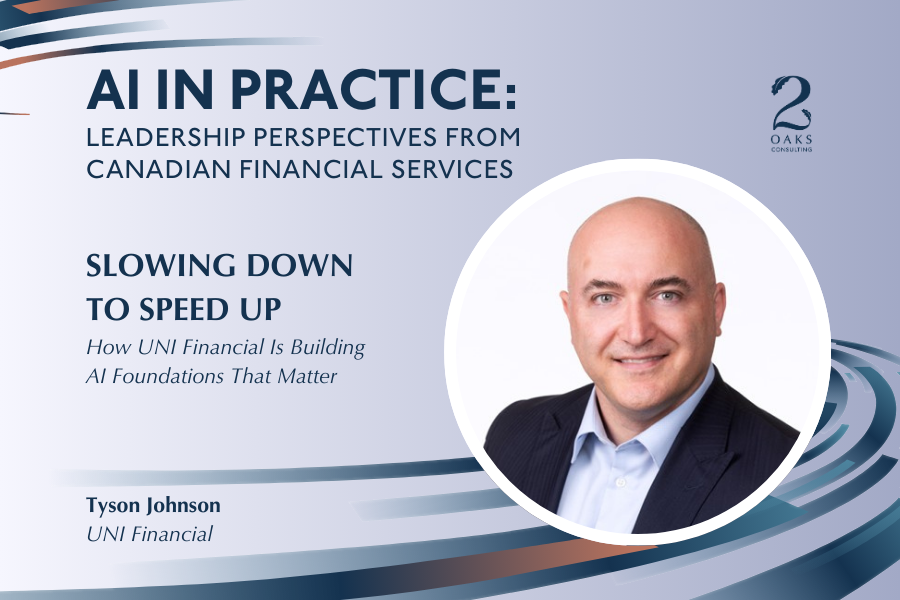
Tyson Johnson explains why organizational readiness and common language come before rapid deployment.
“Don’t feel rushed. Slow it down a little bit and ensure there’s a common understanding within the organization before you start leaping into any part of the journey.”
This advice runs counter to nearly everything the technology industry is selling right now. While vendors promise quick transformation and competitors rush to deploy the latest AI capabilities, Tyson Johnson is asking his organization to do something radical: pause, take a breath, and make sure everyone actually understands what they're talking about.
As CIO of UNI Financial, a federally regulated credit union with business lines spanning commercial banking, retail, wealth management, and insurance, Tyson has watched colleagues at other institutions rush headlong into AI deployments. Some have succeeded. Many have stumbled. And the pattern is clear enough that Tyson has chosen a different path.
His approach centers on something far less glamorous than the latest large language model or agentic AI platform: build organizational consensus around what AI actually means, strengthen data foundations that have always needed work, and learn from mistakes before they become catastrophic.
"AI is a very loaded term," Tyson says. "We're trying to make sure we're level-setting on how to think about it."
This isn't the typical AI playbook for 2025. There are no promises of immediate productivity gains. Instead, Tyson speaks about frameworks, governance structures, and the unglamorous work of ensuring data quality. For someone whose career spans intelligence work with the federal government, cybersecurity leadership at CyberNB, and technology strategy roles across sectors, it's an approach grounded in his personal experience about what makes technology initiatives succeed.
"If you look at the old intelligence days, garbage in, garbage out is still absolutely relevant today," Tyson notes, "and it's even more relevant with AI."
When Enthusiasm Outruns Infrastructure
UNI's AI journey didn't start with Tyson's measured approach. Like many organizations, the credit union saw early enthusiasm from business units eager to explore what was possible. And like many organizations, that enthusiasm created problems.
"We got a little wrong-footed as an organization," Tyson admits with refreshing candour. "Some of the very eager business units started jumping out in front of this, and we had data and access running amok."
The response could have been to clamp down entirely, stifling innovation in the name of control. Instead, Tyson and his team made the harder choice: they pulled back, addressed the data and access issues, and committed to building proper infrastructure before accelerating again.
That infrastructure takes the form of a citizen developer initiative planned for serious rollout in 2026. These business unit representatives will function like data stewards, understanding what exemplary implementations look like, knowing when to raise concerns, and participating in regular governance discussions. They'll have guardrails both from policy and technical perspectives, but also the freedom to innovate within those boundaries.
It's a recognition that the problem wasn't enthusiasm itself but rather the lack of structure to channel it productively. "Just because the IT group is aligned and on board doesn't mean the rest of the organization is," Tyson reflects. "Bringing business intelligence and the businesses units in tighter is probably where we should have started and where we're going now."
“Bringing business intelligence and the businesses units in tighter is probably where we should have started and where we’re going now.”
The lesson applies beyond UNI. Technology readiness is necessary but insufficient. Without organizational readiness, even the best technical implementations flounder.
Building Consensus from the Board Down
Part of that organizational readiness requires alignment at the highest levels. UNI is establishing a technology committee within its Risk Committee specifically to facilitate board-level conversations about AI strategy.
The goal isn't simply to inform the board about technology decisions that have already been made. It's to create substantive dialogue about two interrelated risks: implementing AI poorly and failing to implement AI at all. Both carry consequences, and board members need frameworks to think through the trade-offs.
To accelerate shared understanding, Tyson is introducing his executive team to "Reshuffle," a book that translates AI concepts into business language rather than technical jargon. "You can't spend enough time educating and creating a common framework of understanding across the senior executive team and the board," he emphasizes.
“You can’t spend enough time educating and creating a common framework of understanding across the senior executive team and the board.”
This investment in a common language may seem like a luxury when competitors are shipping products. Tyson sees it as essential groundwork. Strategic conversations require shared vocabulary. Without it, discussions devolve into people talking past each other, using the same terms to mean different things.
The payoff comes later, when the organization can move decisively because everyone understands both the destination and the reasoning behind it.
Where Early Bets Are Paying Off
Despite the deliberate overall pace, UNI has seen promising results in specific areas where conditions aligned for success.
Commercial and enterprise banking emerged as early proof-of-concept units, driven by what Tyson describes as a "perfect storm." The teams faced genuine efficiency pressures around mortgage renewals. They had strong internal technical talent who understood SharePoint and Power BI. And critically, they wanted to serve as organizational pioneers.
"They wanted to be that POC business unit and move forward and look at automation optimization of different processes to drive benefits to the organization," Tyson says.
Meanwhile, project management offices and enterprise architecture groups have begun piloting Microsoft Copilot to improve individual productivity. These smaller implementations provide learning opportunities without significant organizational risk.
Call centre optimization remains under discussion, though any implementation there will follow the more disciplined framework the organization is establishing rather than the ad hoc approach that caused early problems.
The pattern across these initiatives is selectivity. Rather than trying to deploy AI everywhere simultaneously, UNI is identifying areas where business need, technical capability, and organizational readiness converge.
Reimagining CRM Through Data Rather Than Tools
Ask Tyson what he'd implement tomorrow with unlimited resources, and his answer reveals how differently he thinks about technology strategy than many of his peers.
Rather than naming a vendor platform or specific application, he describes a vision he calls "CRM 3.0", a reimagining of customer relationship management not through new software purchases but through better use of data the organization already possesses.
"We're looking at how to generate value in the organization through data to deliver the specific outcomes or insights that each business partner is looking for without necessarily having to buy a specific CRM tool," Tyson explains. "Leverage Microsoft's stack of tools to build the right models and deliver the data those stakeholders need to see."
“We’re looking at how to generate value in the organization through data to deliver the specific outcomes or insights that each business partner is looking for without necessarily having to buy a specific CRM tool.”
This approach aligns with Tyson's concept of "ubiquitous data": UNI's ability to view across multiple business verticals, including commercial banking, retail, wealth management, registered products, and insurance. Operating in a multi-cloud environment with Azure and Amazon, the technical foundation exists to connect these data sources in new ways.
Tyson states, "We’ve gone fully cloud. So now it’s about how we can leverage the multiple verticals we have to see across each one and drive insights to improve member outcomes, member engagement, next best offer, and cross-wallet share opportunities. We want to service our members better and enhance our ability to win wallet share with them.”
“We’ve gone fully cloud. So now it’s about how we can leverage the multiple verticals we have... and enhance our ability to win wallet share.”
The vision extends beyond member-facing applications to employee experience. "I think on both the member experience and the employee experience," Tyson emphasizes. Reducing manual entry, minimizing operational losses from errors, and building confidence in processes that deliver outcomes “allows employees to focus on higher-value activities within the chain, and it gives the members many options of how to bank with us."
The Consolidation Imperative
Tyson's strategic thinking is shaped by competitive dynamics unique to Canadian credit unions. With roughly 170 credit unions nationwide and consolidation accelerating, every institution faces a blunt question: Will you be doing the consolidating, or getting consolidated?
Digital capabilities increasingly determine the answer. Credit unions historically succeeded through regional presence and relationships with older demographics. Those advantages erode as younger, digitally native members become the primary growth market.
"Our demographic is changing," Tyson notes. "If we want to remain competitive, we have to appeal to that new persona, and the new persona is all about their smartphone and their ability to do everything digitally. So if you're not there in the next two years, you risk becoming less relevant even in your local jurisdictions where credit unions have existed for years because you won't be the obvious choice for those who are looking digital first."
Looking ahead, Tyson sees clear requirements for remaining competitive. Institutions must excel at digital experiences, immediate access to credit and insurance products, and deliver strong next-best-offer capabilities. “If you're not doing a solid job with them, you're behind the curve," he says. AI capabilities underpin many of these requirements, from the algorithms that generate next-best offers to the automated decisioning that enables immediate credit access.
“If you’re not doing a solid job with them, you’re behind the curve.”
The competitive landscape is shifting in other ways as well. Cross-border competition looks likely within a few years as regulatory changes enable credit unions to operate beyond traditional geographic boundaries. Open banking regulations from the federal government will further reshape how financial institutions compete.
In this environment, AI becomes less about optional innovation and more about competitive survival, and this reality informs Tyson's AI strategy. “We have to stay relevant," Tyson says. "How do you stay front of the pack so that when consolidation knocks on your door, you guys are there to consolidate others, not to be consolidated?" The institutions that will lead consolidation are those that build sustainable AI capabilities on proper foundations, not those chasing headlines with rushed implementations that deliver little value.
Assessing What Actually Matters
Tyson uses a framework introduced by a Gartner analyst who presented to UNI's executive team. This framework helps UNI cut through the noise and focus on initiatives that deliver genuine business value. It categorizes AI initiatives into three buckets: "defend" (individual productivity tools used for one’s own benefit), "extend" (implementations that change how the business operates and generate ROI), and "upend" (future-state transformational bets).
"If it's driving individual benefit but not going to be a big ROI and not going to be a game changer," Tyson explains, "let's not drain resources and energy too much on that. But let's really be good at finding those bucket two outcomes that offer ROI from a business systems perspective and changes how a business operates."
This disciplined assessment helps UNI avoid the trap of pursuing every interesting AI application simply because it's possible or because competitors are doing it. "We're not an organization that wants to fail forward fast and often," Tyson says. "We want to be more selective and de-risk our decision."
It's an approach that requires saying no frequently, which can be difficult when business units bring genuine enthusiasm for new capabilities. But Tyson sees selectivity as essential for maintaining focus on initiatives that actually matter.
Staying Above the Algorithm
One concept from "Reshuffle" that resonates particularly strongly with Tyson is what he calls staying "above the algorithm." As AI systems increasingly automate routine work, employees whose roles consist primarily of tasks that algorithms can handle will find their value proposition eroding.
"For each employee, regardless of what level you're at, there's an interesting new reality in the world today on this whole AI journey," Tyson explains. "As you assess your own professional development path, ask yourself, are you staying above the algorithm? Are you staying above a place where you can continue to drive value based on your ability to provide insights that otherwise aren't there, or your ability to help train algorithms, or your ability to be that human in the loop that adds that value?"
“As you assess your own professional development path, ask yourself, are you staying above the algorithm? Are you staying above a place where you can continue to drive value based on your ability to provide insights that otherwise aren’t there, or your ability to help train algorithms, or your ability to be that human in the loop that adds that value?”
This isn't meant to frighten people but rather to encourage conscious career development. Employees who focus on providing unique insights, training and refining AI models, or serving as essential judgment points, will continue to create value. Those who don't adapt will find themselves increasingly commoditized.
Tyson sees this as a shared responsibility. He explains, "There's the onus on the person to continue to find ways to drive value in their role. And then there's also the onus on the organization to empower those employees with the right tools." While employees need to seek opportunities to grow and evolve their roles, organizations need to provide tools, training, and pathways for that evolution.
The balance matters. AI absolutely will change what work looks like and which skills command premium value. Pretending otherwise does employees no favours. But creating organizational dynamics that emphasize change as augmentation (i.e. employee effectiveness, tool enablement, and skill development) generates very different outcomes than approaches focused solely on cost and headcount reduction.
What Good Partnerships Look Like
Given UNI's focus on frameworks and foundations over rapid tool deployment, Tyson's partnership criteria differ from those of many technology leaders shopping for vendors.
"We're looking less about tool providers than we are about thought leadership support," he says directly. "Working with partners who can bring in that thought leadership on how to think better about data, data governance, and leveraging whether it's agents or machine learning for the insights that we need."
Ideally, these partners would come from industries beyond financial services, bringing cross-sector perspectives on what works and what doesn't. "Get some of those people who've been in early journeys, who have seen success, and understand what that looks like," Tyson suggests. "We could all benefit from that."
Someone who successfully implemented AI or machine learning in a different sector a decade ago may offer a more valuable perspective than another financial services consultant selling the same solutions to every bank and credit union.
“Financial institutions need to think differently about how they’re positioned for the future.”
"Financial institutions need to think differently about how they're positioned for the future," Tyson argues. “We can't forget this technology has been around for decades." Even if mainstream attention is recent, learning from those with longer experience curves makes sense.
Counsel for Technology Leaders
When asked what advice he'd give peers starting their AI journeys, Tyson circles back to his core message about patience and preparation.
"Don't feel rushed," he counsels. "Slow it down a little bit and ensure there's a common understanding across your business stakeholder group within the organization before you start leaping into any part of the journey."
In parallel with that consensus-building, technology leaders should make data governance and data management genuine organizational priorities rather than initiatives that get attention only when problems emerge.
"The thing that you can do in parallel as an IT leader is ensure that data governance and data management continue to be a key priority in the organization," Tyson emphasizes.
The paradox Tyson is betting on is straightforward: the institutions that survive technology transitions aren't always the ones that move first. Often, they're the ones who move thoughtfully. By slowing down now, UNI will ultimately move faster than organizations currently racing ahead on shaky foundations.
Key Takeaways for Technology Leaders
(Summarized by AI)
Before Implementation:
Establish common language and frameworks for discussing AI across the organization
Strengthen data governance foundations before pursuing deployments
Build organizational consensus from the board down
Assess initiatives using frameworks like Gartner's defend/extend/upend categories
During Implementation:
Create citizen developer programs with clear guardrails and governance
Focus on "bucket two" initiatives that genuinely change business operations
Bring business intelligence and business units into alignment with IT
Think augmentation and redeployment rather than replacement
For Long-term Success:
Help employees stay "above the algorithm" through continuous development
Seek thought leadership partners over tool vendors
Look beyond your industry for cross-sector expertise
Don't feel rushed; organizational readiness matters more than speed
Tyson Johnson MA is Chief Information Officer at UNI Financial, a federally regulated credit union operating multiple business lines, including commercial banking, retail, wealth management, registered products, and insurance. His career spans intelligence work with the federal government, cybersecurity leadership at CyberNB (where he served as COO, Executive Director, and President/CEO from 2018-2021), and technology strategy roles across sectors. He holds a Master of Arts from Tufts University's Fletcher School of Law and Diplomacy and joined UNI Financial as Chief Information Security Officer in December 2021 before being appointed CIO in 2023. He volunteers with his local SPCA and the Hospital for Sick Children (SickKids).
This interview is part of 2Oaks' CIO Spotlight Series, featuring technology leaders sharing practical insights on implementing AI in financial services. To learn more about how 2Oaks helps financial institutions navigate AI implementation, visit 2Oaks.ca.