
INTEGRATION CHALLENGES AND THE BANK ACQUISITION PATHWAY
Part 4 of the White Paper: Strategic Consolidations in American Credit Unions
Three of the four parts of this series have covered the forces driving consolidation, the technology decisions that determine whether a merger succeeds, and the charter choices that shape your regulatory future.
This final piece covers what happens when you actually execute, and a transaction type most U.S. credit union boards have never put on their agenda.
The Predictable Ways Mergers Fail
Credit union mergers fail or underperform for reasons that are well documented and almost entirely avoidable. Filene Research Institute’s 2026 work on merger outcomes is direct on the point: cultural alignment, trust, and governance fit determine deal success more reliably than financial metrics alone. Many transactions that look ideal on paper collapse due to leadership conflict or misaligned risk tolerances.
The highest-risk element of any credit union merger is the core banking system migration.
Data quality issues in legacy systems surface during conversion attempts. Interfaces to ancillary systems, cards, loans, payments, and digital banking, require extensive testing. Member-facing disruptions during conversion weekends damage trust and cause attrition that takes years to recover. Successful integrations begin technology planning 12 to 18 months before close, conduct thorough data remediation, test exhaustively in non-production environments, and prepare detailed rollback procedures.
Governance transition is the failure mode most boards underestimate. Retained directors from acquired institutions need meaningful roles beyond symbolic representation. Governance frameworks require updating to reflect increased scale and complexity. Decision-making processes that worked for smaller institutions become bottlenecks. Boards that fail to establish clear governance transition plans before close, covering board composition, committee structures, policy approval authorities, and management reporting, create paralysis during the most critical early integration phases.
Member value proposition ambiguity is the third common failure. Members of acquired credit unions question why the merger benefits them. Without clear communication about service improvements, product enhancements, or rate advantages, they perceive consolidation as cost-cutting that reduces convenience. The First Tech/DCU combination announced a new fee schedule on its January 2026 effective date that the combined credit union estimates will return roughly $6 million to members in the first year. That is the kind of concrete, early signal that builds member trust through a transition.
Regulatory coordination failures round out the list. Merger approvals come with conditions and reporting requirements. Institutions that lose focus on regulatory commitments while executing operational integration face enforcement actions and relationship damage with supervisors. For transactions crossing the $10 billion threshold, the CFPB layer adds further coordination requirements that boards must anticipate during integration planning.
These challenges are manageable through disciplined program management, realistic scheduling, adequate resourcing, and executive commitment. Credit unions that treat integration as strategic execution rather than operational cleanup achieve target synergies faster and with higher member retention.
The Transaction Type Most Boards Have Not Considered
Credit union acquisitions of community banks have moved from a niche transaction type to a meaningful share of U.S. bank M&A activity. The 22 deals announced in 2024 set an all-time record. 16 were announced in 2025, down from the peak but still high by historical standards. Through November 2025, credit unions accounted for roughly 10 percent of all announced U.S. bank acquisitions.
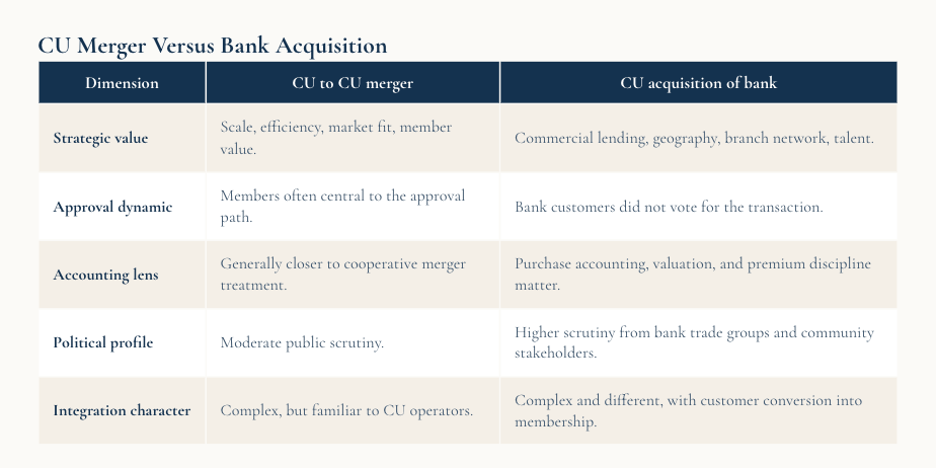
Three motivations recur in announced deals. Geographic expansion: bank charters typically come with branch networks, commercial customer relationships, and market presence that would take years to build organically. Commercial lending capability: many community banks have well-developed commercial real estate, small business, and agricultural lending teams whose expertise transfers usefully to an acquiring credit union. Talent and management depth: bank acquisitions can bring in experienced commercial bankers, treasury management specialists, and risk management staff who are difficult to recruit individually.
The transaction type is different from a credit union merger in ways that matter operationally. Bank acquisitions involve purchase accounting rather than the carry-over of retained earnings used in credit union mergers. Acquired bank customers did not vote in favor of the deal and must be converted to credit union membership. Commercial loan portfolios often require remapping to credit union member business loan rules. Brand transitions are typically more abrupt than in credit union mergers.
The political environment adds another layer. Bank trade associations have been increasingly vocal in opposing these transactions. The Independent Community Bankers of America estimates that credit unions avoided approximately $4.3 billion in federal income taxes in 2025 and has called for ending the federal tax exemption for credit unions over $1 billion in assets. Boards should treat public-policy narrative as part of deal execution, not as a post-announcement communications task.
Despite the complications, practitioners expect continued 2026 activity. Boards that have ruled out bank acquisitions on principle should revisit that decision against current data. Boards exploring this path should engage specialized counsel early and test the transaction type against current deal economics.
What This Series Has Covered
Four weeks, four sections of the 2Oaks 2026 U.S. Credit Union M&A Framework. The consolidation data that shows the scale shift is structural and accelerating. The technology decisions that determine whether your integration takes six months or two years. The charter choices that either open or close your strategic options. And the integration disciplines and transaction types that separate institutions that execute well from those that do not.
The full 25-page framework can be downloaded here.
The Cybersecurity Dimension
Regulators scrutinize cybersecurity readiness during merger approvals. Credit unions with mature security operations, incident response capabilities, and continuous monitoring face fewer obstacles in gaining regulatory consent for acquisitions. Those without them introduce a risk variable that can slow approval timelines and complicate integration planning.
Member Driven Technologies’ 2025 review of credit union operating conditions identified rising vendor complexity and AI-generated fraud as among the year’s sharpest operational pressures. Cybersecurity is no longer a back-office function in a merger context. It is a due diligence variable.
The Bottom Line
The technology gap between leaders and laggards in the U.S. credit union market is widening. Credit unions that delay digital transformation integrate acquisitions slowly and at higher cost, lose members to more convenient competitors, and become less attractive to the well-positioned institutions they would most want to partner with.
Technology investment is not optional for credit unions pursuing growth through M&A. The full framework, including the integration timeline comparison and the four-phase execution model, can be downloaded below (Click on the image below).
ABOUT 2OAKS
2Oaks emerged from deep within the banking sector, where our founders personally navigated the challenges of core system modernization. This hands-on experience shaped our unique approach to technology consulting -one that combines technical expertise with practical wisdom. We're not your typical consultancy. As a vendor neutral partner, we work exclusively for our clients' interests across banking, financial services, retail, and public sectors.
What sets us apart is our commitment to co-creation and knowledge transfer. We work alongside your team, ensuring that our solutions aren't just implemented but truly integrated into your organization. Our lean, efficient approach eschews unnecessary complexity in favour of practical, results-driven outcomes. Whether you're facing a system transformation, technology upgrade, or strategic shift, reach out to 2Oaks to discover how our principled, authentic approach can drive your success.