
FINDING THE BALANCE
THIRTY YEARS AGO, YOU WERE MORE LIKELY TO HEAR ABOUT ARTIFICIAL INTELLIGENCE IN A SCIENCE FICTION NOVEL THAN A BUSINESS REPORT.
Today, artificial intelligence (AI) and machine learning (ML) have moved from fiction to reality and new practical business applications emerge every day. As organizations race to implement these technologies, the conversation has shifted from "if" to "how" we should integrate AI into our workflows and customer experiences. This article will help you find the right balance for your business.
WHAT IS IT?
DEFINITIONS
Artificial Intelligence refers to computer systems designed to perform tasks that typically require human intelligence. These include problem-solving, language understanding, visual perception, decision-making, and adapting to new situations. Machine Learning, a subset of AI, focuses on systems that can learn from and improve with experience without being explicitly programmed for every scenario.
Modern AI systems range from rule-based algorithms to sophisticated neural networks that can process vast amounts of data to recognize patterns, make predictions, and generate human-like content. Deep learning, a specialized form of machine learning, uses multi-layered neural networks to analyze complex data such as images, speech, and natural language.
KEY APPLICATIONS:
Key applications include:
Natural Language Processing (NLP) for understanding and generating human language
Computer Vision for interpreting visual information
Predictive Analytics for forecasting trends and behaviours
Automated Decision Systems for making or supporting complex choices
Robotics and process automation for physical and digital tasks
WHY IT MATTERS
SIGNIFICANCE:
The significance of AI and ML extends beyond technological advancement—it represents a fundamental shift in how businesses operate and how people work. Organizations in banking, financial services, commerce, and the public sector implementing AI solutions can achieve remarkable improvements in efficiency, customer experience, and innovation capacity.
TRANSFORMATION:
AI is already transforming these industries by:
Enabling personalized experiences at scale
Automating routine and repetitive tasks
Uncovering insights from massive datasets
Accelerating research and development
Creating new products and services previously impossible
Enhancing regulatory compliance and fraud detection
Improving risk assessment and management
However, as with any powerful technology, the implementation approach determines whether AI enhances or diminishes the human experience.
THE PROMISE & BENEFITS OF AI
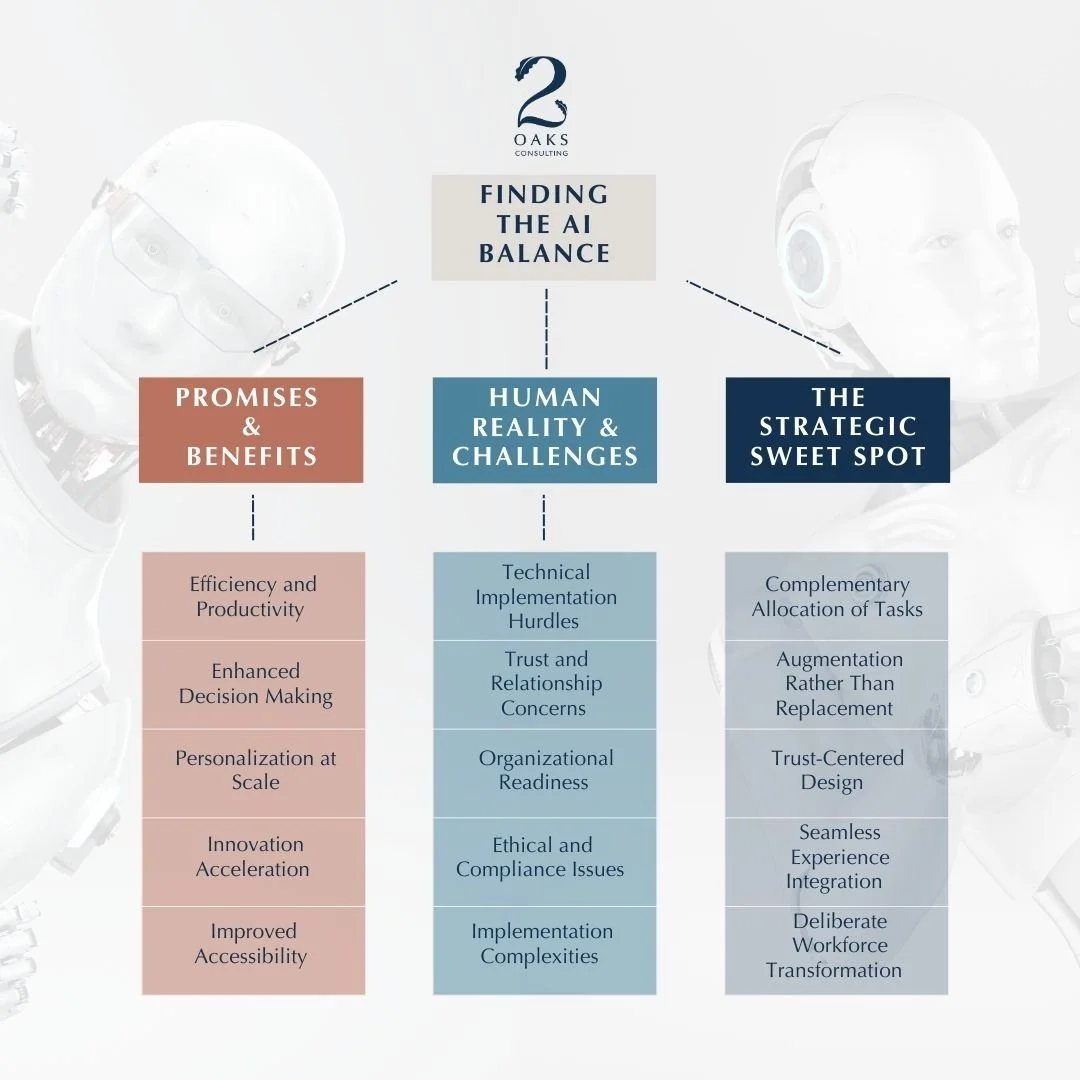
As organizations implement AI and machine learning solutions, they quickly discover that success lies not in wholesale adoption but in thoughtful integration. Understanding both the promise and reality of these technologies is essential for finding the optimal balance.
AI TECHNOLOGIES OFFER COMPELLING ADVANTAGES ACROSS INDUSTRIES.
Efficiency and Productivity
Immediate 24/7 responsiveness to customer and operational needs
Processing vast amounts of data beyond human capacity
Automating repetitive tasks with unwavering consistency
Significant cost savings through operational streamlining
Enhanced Decision Making
Data-driven insights that reduce cognitive biases
Pattern recognition across massive datasets
Predictive capabilities that anticipate needs and problems
Consistent application of complex rules and regulations
Personalization at Scale
Customized experiences for thousands or millions of users simultaneously
Adaptive interfaces that learn from user behaviour
Tailored recommendations and solutions
Real-time adjustments to user preference
Innovation Acceleration
Rapid testing of multiple hypotheses
Identification of non-obvious connections and opportunities
Simulation of complex scenarios
Creative generation of new product and service concepts
Improved Accessibility
Breaking down language and communication barriers
Creating interfaces adaptable to diverse needs
Expanding service availability beyond traditional constraints
Democratizing access to specialized knowledge
THE HUMAN REALITY AND CHALLENGES
HOWEVER, IMPLEMENTATION OFTEN REVEALS SIGNIFICANT CHALLENGES:
Technical Implementation Hurdles
Frustrating interaction loops when systems can't understand context
Integration difficulties with legacy systems
Data quality and availability constraints
Costly infrastructure and expertise requirements
Trust and Relationship Concerns
Erosion of trust in sensitive client-advisor relationships
Lost context during handoffs between AI and human representatives
Depersonalization of traditionally high-touch services
Transparency issues with "black box" decision systems
Organizational Readiness
Workforce anxiety about changing roles and responsibilities
Skills gaps for effective AI implementation and management
Resistance to process changes required for AI adoption
Governance challenges for algorithmic decision-making
Ethical and Compliance Issues
Potential amplification of existing biases in training data
Privacy concerns with data collection and usage
Regulatory uncertainty in rapidly evolving landscapes
Accountability questions for automated decisions
Implementation Complexities
Difficulty defining appropriate success metrics
Challenges in moving from pilot to production
Ongoing maintenance and monitoring requirements
Security vulnerabilities in connected systems
THE STRATEGIC SWEET SPOT
THE MOST SUCCESSFUL ORGANIZATIONS FIND A MIDDLE PATH THAT LEVERAGES THE STRENGTHS OF BOTH AI AND HUMAN CAPABILITIES:
Complementary Allocation of Tasks
Using AI to handle routine, repetitive processes
Reserving human attention for complex decisions and relationship building
Creating clear protocols for when issues should escalate to human intervention
Augmentation Rather Than Replacement
Deploying technology to enhance professional expertise
Providing AI tools that amplify human capabilities
Designing systems that make humans more effective, not obsolete
Trust-Centered Design
Building solutions that strengthen rather than dilute client trust
Ensuring appropriate transparency in AI-driven processes
Maintaining human oversight for sensitive decisions
Seamless Experience Integration
Creating invisible transitions between automated systems and human experts
Ensuring context preservation during handoffs
Delivering consistent experience quality across all touchpoints
Deliberate Workforce Transformation
Retraining employees to work effectively with AI systems
Creating new roles that leverage uniquely human skills
Developing governance frameworks for human-AI collaboration
This balanced approach recognizes that the goal isn't efficiency at the expense of effectiveness but rather finding the optimal combination that enhances both operational performance and human experience. Success with AI technology requires maintaining the personal touch while leveraging AI's capabilities to enhance service delivery.
FINDING THE RIGHT BALANCE
WHAT MAKES FOR SUCCESS?
The most successful AI implementations recognize that the goal isn't to replace humans but to enhance human capabilities. This means:
Start with human needs: design AI systems that address real pain points for employees and customers
Create collaborative workflows: establish clear handoffs between AI systems and human experts
Maintain human oversight: ensure humans remain in control of sensitive decisions and edge cases
Invest in skills development: prepare employees to work effectively alongside AI tools
Measure holistic impact: evaluate AI not just on efficiency metrics but on customer and employee satisfaction
REAL-WORLD EXAMPLE:
JPMORGAN CHASE’S COIN PLATFORM
JPMorgan Chase provides an excellent case study of finding the balance between AI capabilities and human expertise in financial services. In 2017, the bank introduced COIN (Contract Intelligence), an AI-powered system designed to review and interpret commercial loan agreements.
THE PROBLEM
Previously, interpreting these complex legal documents consumed approximately 360,000 hours of work annually from lawyers and loan officers. The process was not only time-consuming but prone to human error and inconsistency.
THE AI SOLUTION
COIN uses machine learning and natural language processing to:
Extract key data points from loan documents
Identify critical clauses and terms
Flag potential issues for human review
Standardize interpretation across thousands of contracts
THE HUMAN COMPONENT
Rather than eliminating the role of legal professionals, JPMorgan Chase redesigned their workflow:
AI handles the initial document review and data extraction
Legal experts focus on analyzing flagged issues and edge cases
Relationship managers use the extracted insights to provide better client advice
The legal team maintains oversight of the system and regularly reviews its accuracy
THE RESULTS
This human-AI collaboration has delivered significant benefits:
99% reduction in document review time (from hours to seconds)
Decreased loan-servicing mistakes
More consistent contract interpretation
Improved client experience with faster processing
Legal staff redeployed to higher-value advisory work
These results have been reported in multiple sources, including JPMorgan Chase's own technology publications, Bloomberg, and Harvard Business Review. The initiative is part of the bank's broader strategy to use AI and machine learning to improve efficiency and accuracy across operations.
Most importantly, JPMorgan recognized that the system works best with human oversight. Legal professionals regularly review the AI's interpretations and provide feedback that improves the algorithm. This creates a virtuous cycle where the AI system becomes more accurate while the human experts develop new skills and focus on more strategic work.
This example demonstrates how financial institutions can leverage AI to handle routine processing while enhancing, rather than replacing, the human expertise that clients ultimately value most.
INDUSTRY-SPECIFIC APPLICATIONS
BANKING AND FINANCIAL SERVICES
Beyond contract review, AI is revolutionizing financial services through:
Fraud detection systems that identify suspicious patterns in real-time
Credit scoring models and loan adjudication systems that assess risk more accurately, process applications more efficiently, and make lending decisions more inclusively
Customer service chatbots that handle routine inquiries, with seamless handoffs to human advisors for complex matters
Algorithmic trading with human oversight for market anomalies
Anti-money laundering systems that flag suspicious transactions for human investigation
COMMERCE
In the retail and e-commerce sectors, the human-AI balance is equally important:
Inventory management systems that predict demand patterns while buyers add market intuition
Recommendation engines that personalize offerings while human merchandisers curate collections
Dynamic pricing models with strategic overrides from pricing managers
Customer journey analytics informing human-designed experiences
Supply chain optimization with human judgment for unusual circumstances
PUBLIC SECTOR
Government agencies are finding their own AI-human balance through:
Benefits processing automation with case workers focusing on complex situations
Predictive maintenance of infrastructure with engineer oversight
Public safety analytics informing but not replacing human decision-making
Citizen service platforms that route complex needs to appropriate staff
Policy impact modeling to inform human policymakers
CONCLUSION
THE FUTURE OF AI ISN'T ISN'T A BINARY CHOICE BETWEEN TECHNOLOGY AND HUMANITY. RATHER IT IS A CAREFUL CONSIDERATION OF WHERE EACH EXCELS.
Organizations in banking, financial services, commerce, and the public sector that approach AI implementation with this mindset will be best positioned to realize its benefits while mitigating its challenges.
As you navigate your AI journey, remember that the goal should be enhancing, not replacing, the human touch that builds relationships and trust. With thoughtful implementation, AI can handle routine tasks while freeing people to do what they do best: connect, create, and care.
Need help finding the sweet spot? 2Oaks can help you navigate the complexities of your AI journey in banking, financial services, commerce, and public sector environments. Our expertise in these industries ensures solutions that balance technological innovation with human-centred design.
DOWNLOAD THE PDF DOCUMENT BELOW:
ABOUT 2OAKS
2Oaks emerged from deep within the banking sector, where our founders personally navigated the challenges of core system modernization. This hands-on experience shaped our unique approach to technology consulting—one that combines technical expertise with practical wisdom. We're not your typical consultancy. As a vendor-neutral partner, we work exclusively for our clients' interests across banking, financial services, retail, and public sectors.
What sets us apart is our commitment to co-creation and knowledge transfer. We work alongside your team, ensuring that our solutions aren't just implemented but truly integrated into your organization. Our lean, efficient approach eschews unnecessary complexity in favour of practical, results-driven outcomes. Whether you're facing a system transformation, technology upgrade, or strategic shift, reach out to 2Oaks to discover how our principled, authentic approach can drive your success.