
MASTERING BUSINESS PROCESS MAPPING
TODAY'S BUSINESS ENVIRONMENT IS COMPLEX. SUCCESS REQUIRES MANY ACTIVITIES AND TASKS TO WORK TOWARD A SPECIFIC OUTCOME.
But who knows what's really going on, and what happens when those who do know leave the organization?
Consider a mid-sized manufacturer that faced production delays and quality issues after two long-tenured production managers retired simultaneously. With their specialized knowledge of calibration procedures and quality protocols undocumented, the company endured three months of missed deadlines and rejected orders—all because critical processes existed only as tribal knowledge rather than as documented standards transferable to new team members.
Effective process management is a critical differentiator between thriving organizations and those that struggle. Yet despite widespread acknowledgment of its importance, the reality remains stark: everyone talks about business processes, but very few organizations execute them well.
THE PROCESS DOCUMENTATION CRISIS
MANY BUSINESSES OPERATE ON TRIBAL KNOWLEDGE—INFORMATION PASSED DOWN THROUGH EXPERIENCE RATHER THAN FORMAL DOCUMENTATION.
While this institutional knowledge is valuable, its informal nature creates significant vulnerabilities. Without proper documentation, organizations lack a comprehensive understanding of exactly how their business functions, leading to:
Inefficiencies and redundancies in operations
Dangerous dependence on key individuals who hold critical knowledge
Frequent errors and inconsistencies in execution
Significant challenges when attempting to scale operations
Difficulty in training new employees efficiently
When processes exist primarily in people's heads rather than in accessible documentation, the organization becomes vulnerable to knowledge loss when employees leave or change roles.
BUILDING A PROCESS-DRIVEN ORGANIZATION
Addressing these challenges requires more than casual commitment. Because business processes typically cross departmental boundaries, successful documentation and improvement initiatives need dedicated champions who can navigate organizational complexity.
THE ROLE OF THE PROCESS CHAMPION
An effective process champion must:
Establish governance frameworks: Set clear rules, guidelines, and standards for process documentation and management. This creates consistency and ensures quality across all documented processes.
Select appropriate technology: Determine what software solutions (if any) will best support the organization's process automation and management needs. This might range from simple document repositories to sophisticated Business Process Management Systems (BPMS).
Choose modeling methodologies: Identify which process modeling techniques and tools will most effectively capture the organization's workflows in an understandable, usable format.
Drive stakeholder engagement: Secure buy-in from all relevant departments and management levels. Without broad support, process initiatives often stall or deliver limited value.
Lead change management: Guide the organization through the cultural and operational shifts that inevitably accompany process improvement initiatives.
PROCESS MODELING TECHNIQUES: FINDING YOUR APPROACH
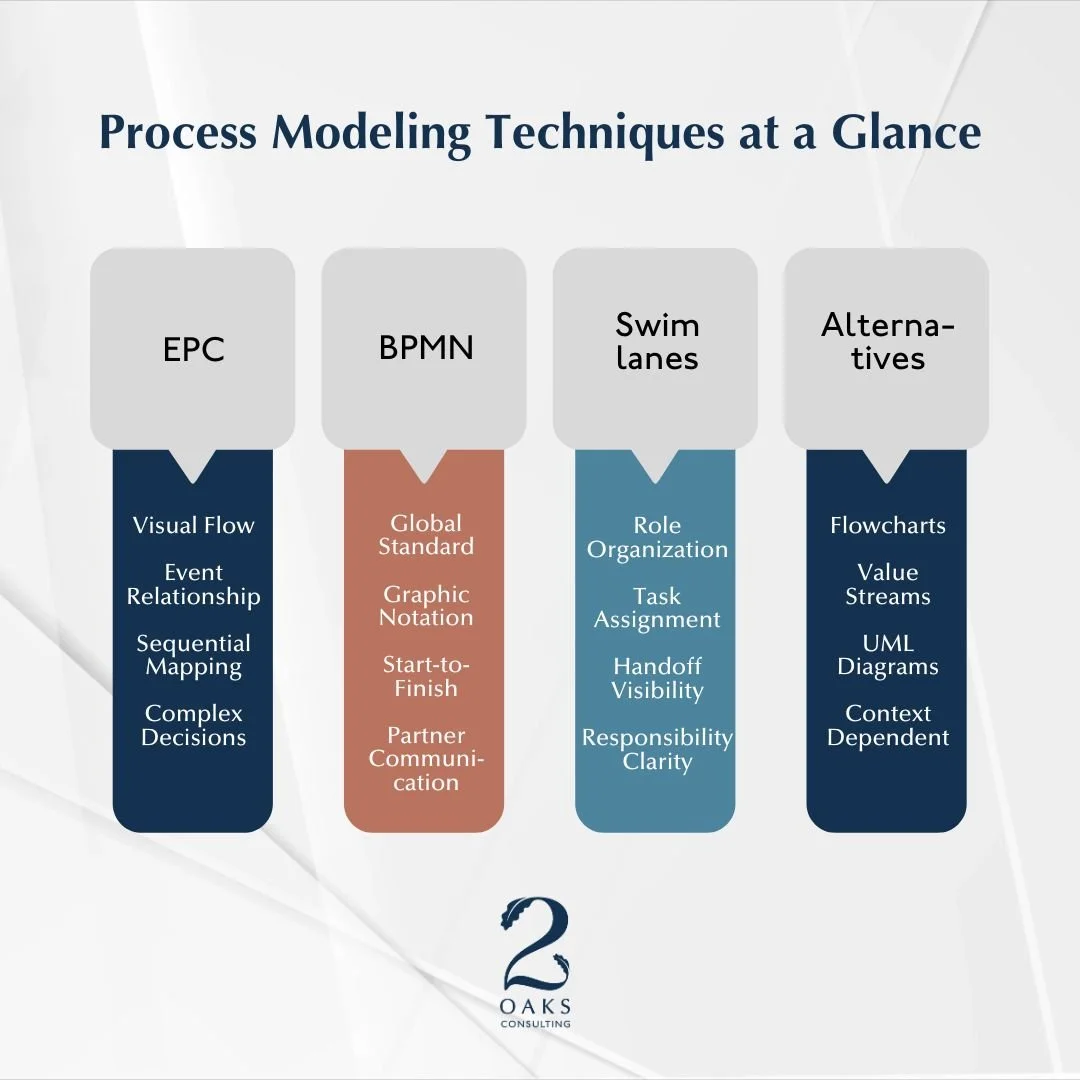
Selecting the right methodology for documenting processes is crucial for success. Several established techniques offer different advantages depending on your organization's needs:
EVENT-DRIVEN PROCESS CHAIN (EPC)
This technique visually represents the flow of activities, events, and decisions within an organization. EPC captures relationships between events and functions, providing a clear understanding of process sequences and dependencies. It's particularly useful for organizations that need to model complex decision paths and event triggers.
BUSINESS PROCESS MODELING NOTATION (BPMN)
As the global standard for modeling business processes, BPMN provides a comprehensive graphical notation for specifying business processes in a Business Process Diagram (BPD). It depicts the flow of activities from start to finish, making workflows more effective and efficient. BPMN is ideal for organizations seeking a standardized approach that facilitates communication with external partners and vendors
SWIMLANES
This visual mechanism organizes and categorizes activities within a process by role or department. Swimlanes delineate who performs specific tasks by placing steps within horizontal or vertical lanes, highlighting connections, communication, and handoffs between different roles or departments. This approach excels at clarifying responsibilities and identifying handoff points where processes often break down.
ALTERNATIVE APPROACHES
Beyond these common methodologies, organizations may adopt other techniques such as flowcharts, value stream mapping, or Unified Modeling Language (UML) activity diagrams. The key is selecting an approach that matches your organization's complexity, culture, and objectives.
THE ORGANIZATIONAL IMPACT OF WELL-DOCUMENTED PROCESSES
WHEN DONE PROPERLY, BUSINESS PROCESS DOCUMENTATION CREATES VALUE ACROSS THE ENTIRE ORGANIZATION:
Business Operations: Front-line teams gain clarity on standard procedures, reducing errors and improving efficiency.
Technical Operations: IT teams better understand the business context of systems they support, leading to more effective solutions.
Management Decision-Making: Leaders can make more informed strategic and tactical decisions based on accurate process information.
Strategic Initiatives: Change efforts are grounded in a clear understanding of current operations, improving implementation success.
CONCLUSION: MOVING FORWARD
EVERY ORGANIZATION, REGARDLESS OF SIZE OR INDUSTRY, NEEDS A ROBUST REPOSITORY OF BUSINESS PROCESSES.
Without this foundation, scaling, improving, and adapting the business becomes unnecessarily challenging. With the right leadership, methodologies, and organizational commitment, your business can transform tribal knowledge into a strategic asset that drives performance, continuity, and growth.
2Oaks Consulting specializes in helping organizations develop, document, and optimize their business processes across all major mapping methodologies. Our experienced team can guide your organization through each step of the journey—from initial assessment and champion selection to full implementation and continuous improvement.
Contact 2Oaks today to turn process challenges into competitive advantages that enhance efficiency, reduce operational risk, and support sustainable business growth.
DOWNLOAD THE PDF DOCUMENT BELOW (CLICK ON THE IMAGE):
ABOUT 2OAKS
2Oaks emerged from deep within the banking sector, where our founders personally navigated the challenges of core system modernization. This hands-on experience shaped our unique approach to technology consulting—one that combines technical expertise with practical wisdom. We're not your typical consultancy. As a vendor-neutral partner, we work exclusively for our clients' interests across banking, financial services, retail, and public sectors.
What sets us apart is our commitment to co-creation and knowledge transfer. We work alongside your team, ensuring that our solutions aren't just implemented but truly integrated into your organization. Our lean, efficient approach eschews unnecessary complexity in favour of practical, results-driven outcomes. Whether you're facing a system transformation, technology upgrade, or strategic shift, reach out to 2Oaks to discover how our principled, authentic approach can drive your success.