
REMOVING THE DRUDGERY: HOW GENERAL BANK OF CANADA USES AI TO ELEVATE HUMAN WORK
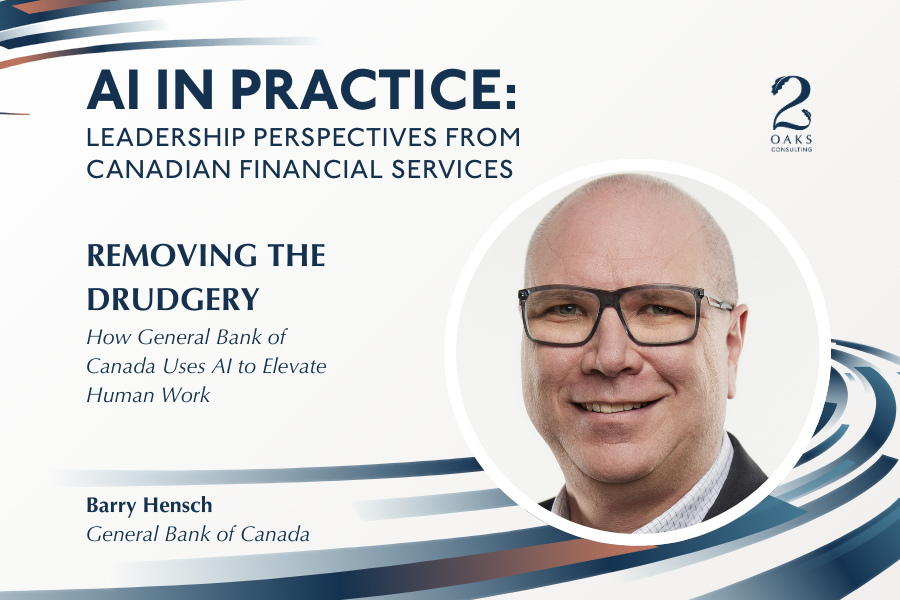
Barry Hensch explains why AI's real value lies in eliminating tedious tasks so people can focus on what matters most.
“Drudgery is not fulfilling and takes a lot of time. The more we can get rid of the drudgery, the better.”
Barry Hensch, Chief Technology Officer at General Bank of Canada, uses this principle to guide every AI decision at the bank. While others chase trends or compete on features, Barry focuses on a more straightforward question: what tedious, unfulfilling work can AI eliminate so people can do more meaningful work?
General Bank of Canada already operates as one of the most efficient banks in the country, ranking third among Canadian banks for the lowest efficiency ratio. Yet Barry sees enormous opportunity to do even better. "General Bank is bullish on how AI and related tools can help us become even more efficient," he explains. "We see lots of opportunities for further automation."
What sets Barry's approach apart, however, is his focus on a specific goal: removing drudgery. "We as humans, while we tend to be pretty good at the drudgery, like the administrative work that just happens, it's also not particularly fulfilling and takes a lot of time. So the more we can get rid of the drudgery, the better.”
This philosophy shapes everything GBC is doing with AI.
Four Focused Initiatives
"We're working on four different things in various ways at the moment," Barry explains. The clarity of this focus stands out in an industry often chasing every AI trend.
First, GBC has embraced generative AI for content creation, transcription, and summarization. "We see lots of potential… including creating content or transcribing and summarizing, whether it's meetings or taking large corporate documents through our enterprise-grade solution," Barry describes the breadth of applications.
Second, the bank is using AI for training and microlearning with impressive speed. "We just released a new 4-minute AI-generated video on our internal whistleblower policy," Barry reports.
“Historically, to have a live actor or somebody narrate took a lot of time and money. The risk team literally did this in a few days using some of the new AI video capabilities.”
This rapid production capability gives GBC the agility to create tailored, timely training content on topics important to the organization without the traditional overhead of video production.
Third, GBC is advancing auto credit adjudication using machine learning. Given that auto loans represent a substantial portion of GBC's book, this application makes strategic sense. Barry notes, "We can start to build models using machine learning techniques to decide from an automation point of view whether we can approve those and only have the ones that are just on the line or have some questions go to a human for further analysis."
The results show promise. "We've got about 20% of our loans now going through this process, and we're seeing a good success rate. We won't necessarily see the outcome of those until later on, once we've seen how the decisions go, but we feel very confident."
Fourth, GBC is exploring AI for collections, with a particularly innovative twist that addresses Canada's linguistic diversity in a way no other financial institution has publicly discussed.
The 128-Language Advantage: Collections Reimagined
Barry's most striking AI application addresses a challenge every Canadian financial institution faces, yet few discuss openly: how to handle difficult conversations with customers whose first language isn't English or French.
"The biggest bang for us there is actually if we were to send a text message to a customer and have them be able to converse with a chatbot, but in up to 128 different languages," Barry explains.
The use case is specific and powerful. "We’re allowing them to converse on a challenging topic, which is ‘You've not paid your car loan,’ but in the language that's comfortable to them, versus only being in English. That's where AI can actually help us dramatically moving forward."
Barry explains why this matters for big decisions and life-changing events. “Maybe you've recently been in a car accident, and you have a loan with us. Being able to converse in a comfortable language rather than a secondary or third language can really help the ongoing customer experience. I think that's particularly exciting."
This isn't just customer service innovation. It recognizes a reality that many Canadians, particularly recent immigrants, manage their financial affairs in a language they're still mastering. When facing financial stress, the ability to communicate in one's native language could make the difference between resolution and default.
“When facing financial stress, the ability to communicate in one’s native language could make the difference between resolution and default.”
GBC is still in the early stages of investigating this application, but Barry believes "it has enormous promise."
Redeployment, Not Reduction
When employees approach Barry asking what AI means for their jobs, his response is direct. "This is a strategy around making the best use of the human capital we have," he explains. "It's not about reducing headcount. This is about redeploying that headcount in new and interesting ways."
The operations team, GBC's largest department, stands to benefit the most from automation. "If they can make things more efficient for credit decisions for loan processing, all the better. And we get to redeploy the human capital on the important things, the higher value-added activities."
Barry acknowledges this transition creates both excitement and anxiety. Employees "are often very excited about what the future possibilities are, albeit also a little nervous because they’ve been doing their job for five, ten years." Managing this change requires keeping employees a part of the conversation rather than surprising them with initiatives at the last minute.
Progressive Risk, Leading the Way
Although there is interest in AI across the organization, one department has surprised Barry with their enthusiasm.
“The biggest area [of interest] for us has actually been from oour risk team, which is almost counter to what you would normally expect”
The team that produced the AI-generated whistleblower training video? Risk. "They're actually leading the way in some respects, making sure we're doing the right thing and protecting ourselves, but also leveraging these types of tools as extensively as we need to."
This progressive risk posture gives GBC an unusual level of organizational alignment, with the department most responsible for identifying threats also championing innovative solutions.
The Small Bank Advantage in a Changing Landscape
Barry sees GBC's competitive position through a lens broader than traditional bank rivalry. "It's less about what competitors are doing. I don't know that any of our main competitors are doing anything uniquely different. I would say it's more about our ability to stay relevant."
The real competitive threat comes from transformation in the financial services landscape itself. "We've seen such a change in financial services over the last five years, and we will continue to see dramatic changes, especially as open banking becomes a reality in Canada. It's going to be so much more competitive. We need to be relevant and maintain a position."
This is where GBC's size becomes an advantage in this environment.
“We think we can, as a smaller bank, move much faster than the Big Six. So we need to leverage that. That’s our secret sauce moving forward.”
This philosophy extends to AI adoption. Rather than trying to match every capability the big banks announce, GBC focuses on moving quickly where it makes strategic sense. "General Bank is not taking the ‘keep up with the Joneses' type attitude,” Barry explains. “We see more strategic things."
Table Stakes: What's Coming in 2-3 Years
Barry has clear views on which AI applications will become standard practice in banking. "Auto credit adjudication. Lots of FIs have been doing this for years. This is not a new concept, but I think it's going to shift because the technologies are increasingly getting better and the data feeding it is increasingly getting better."
More transformative will be how AI changes the role of financial analysts. "We used to call them quants, the big brains that get in and do the deep financial analysis on a commercial loan," Barry describes. "We'll still need those quants in their deep experience and mathematical mindset. But so much of that can be summarized by a large language model.”
Barry offers the example of “Taking all the financial statements for a company and synthesizing and doing the ratio analysis can take a lot of time. Large language model now reduces that to next to nothing, and then the analyst can spend the time inferring other sorts of risk mitigation techniques necessary."
This shift will face resistance. "There's going to be some resistance because this is the heart and soul of a bank. It's going to be challenging, but it's definitely the direction we're headed, in my opinion."
For software development, agentic AI for automated testing represents another frontier. "Our ability to be successful is going to be largely dictated by how fast we can get products to market," Barry explains. "With legacy core banking systems or other systems that traditionally take 9 or 12 or 18 months to do, that's going to be far too long in the world moving forward. We need to be able to do it in a matter of weeks versus months or quarters."
The Double-Edged Sword: Fraud
If AI creates opportunities for financial institutions, it creates equal opportunities for fraudsters. "Banking is really about trust," Barry notes. "Customers need to trust that we will do right by them, whether it's holding their deposits, their loans, or protecting their data."
The threat landscape is evolving rapidly. "The bad actors of the world are finding more and more sophisticated techniques, whether it's a deep fake video conference, a fraudulent pay stub, income verification, or documents and images to know our customer. Our goal is to protect the risk associated with the bank.”
“We’ve relied on some important techniques that I don’t think we are going to cut it now that the technology is advanced.”
Traditional verification methods are becoming inadequate. Financial institutions must adapt.
The Explainability Challenge
Among AI's technical challenges, explainability concerns Barry. For example, "In the case of an auto credit adjudication, if an application is declined, having the AI model be able to say why. What was the deciding factor of all the elements going into that application that had it decide not to proceed?"
The issue goes deeper than simple transparency. "We're finding that what are traditionally no-brainer type approvals by humans may not be no-brainers [when AI] takes the emotional part out."
This demonstrates the importance of explainability, and Barry is direct about where the industry stands. "That explainability part is huge, and I'm not sure we as GBC or even the industry are quite there yet to be able to feel comfortable around those types of topics."
When AI makes decisions, especially decisions that affect people's lives like loan approvals, the ability to explain the reasoning becomes essential for both regulatory compliance and customer trust. But providing that explanation becomes even more important for what comes next.
“That personal touch is super important”
Barry emphasizes. "You've got a consumer who gets a no. The AI produces a reason why, and then there can be a conversation about how the consumer might be in a position to get a yes the next time they apply.”
This is where AI and human collaboration matters most. The AI handles the data-intensive analysis, but humans provide the empathy and guidance to help customers improve their position for future applications.
Managing the Data Complexity
GBC uses third-party model assessment for explainability and understandability. "Some of those external independent assessments are valuable because they highlight blind spots we hadn't considered," Barry explains.
The challenge in building AI models goes beyond gathering data. "You can throw all kinds of data at the machine learning model, but not all of it is actually relevant, and in some cases, the data can actually skew things."
Determining what data to include requires judgment, collaboration, and sometimes spirited debate. "It's about the collaboration of coming together to come up with something new. Independent advice, our own internal experience, the risk perspective, the lines of defence model, internal audit, all these things factor in."
The Mindset Gap
When asked about GBC's biggest readiness gap for AI, Barry doesn't point to technology as the main issue. "Fundamentally, some of it's still a mindset shift. We've referred to the digital mindset, the growth mindset, all of these things, but there's a different mindset here with leveraging AI that I'm not sure we've completely cracked the nut on."
The question becomes one of adoption and change.
“How do we educate? How do we deal with resistance? I’m not a huge fan of the term “organizational change management” because I think it’s been abused, but it comes back to adoption. how do we better adopt these things in a holistic way that’s good for the organization, good for the cusotmer, and good for our shareholders?”
GBC has technical gaps, too. But as a small team, prioritization matters, and Barry believes the mindset and adoption challenges require the most attention right now.
Advice: Start Small, Start Internal
For technology leaders beginning their AI journey, Barry's advice is practical. "Obviously, you have to start and do your research, do your reading. Leverage large language models for assessments of approaches or governance frameworks."
But research only takes you so far. "Start small. Pick a particular use case. I wouldn't suggest you do it externally with your customers. Don't develop an external chatbot as your first thing. Instead, focus on your internal processes."
“I don’t like the phrase ‘fail fast,’ but the idea here is to learn fast. Adapt and change and see how far you can get.”
Barry emphasizes embracing AI's iterative nature. "These projects are quite different. They're quite iterative. You're going to learn a lot. I don't like the phrase ‘fail fast,’ but the idea here is to learn fast. Adapt and change and see how far you can get."
His final guidance is succinct: "Start small but start internal."
Beyond the Buzzword
Barry brings a refreshing practicality to AI implementation. He navigates hype carefully, and his approach involves "taking a bit of a step back and saying, OK, where is the real value here and where are the case studies showing that?"
For GBC, the value lies in removing drudgery so people can do more fulfilling work; serving customers in 128 languages during difficult moments; making credit decisions faster and more consistently while keeping humans in the loop for complex cases; and producing training content in days instead of months.
These aren't revolutionary moonshots. They're practical improvements that compound into a significant competitive advantage for a smaller bank competing against institutions with vastly more resources.
Barry's thoughts capture what makes AI genuinely valuable. When technology eliminates tedious work, humans can focus on judgment, empathy, problem-solving, and relationship-building. These distinctly human capabilities become more useful and valuable as AI handles routine tasks.
The banks that succeed with AI won't be those that automate their humanity away. They'll be those who use AI to free their people to be more human.
Key Takeaways for Technology Leaders
(Summarized by AI)
Before Implementation:
Start small with internal processes before customer-facing applications
Identify specific areas where drudgery can be removed
Focus on operational efficiency with measurable outcomes
Research thoroughly using AI tools themselves to assess approaches
During Implementation:
Think redeployment, not reduction of workforce
Engage risk and compliance teams early as champions
Use external assessments to identify blind spots in AI models
Keep employees involved throughout the change process
For Long-term Success:
Prioritize explainability in AI decision-making
Focus on mindset shift and adoption, not just technical implementation
Seek partners who will collaborate to create new solutions, not just replicate old ones
Learn fast and adapt rather than trying to avoid failure
Barry Hensch serves as Chief Technology Officer at General Bank of Canada. With over 25 years of experience spanning oil & gas, healthcare, retail, consulting, and financial services, he previously held positions at ATB Financial and Connect First Credit Union (now Servus Credit Union). He holds a bachelor's degree in Advanced Accounting, an MBA with a concentration in Digital Technologies Management, and the Institute of Corporate Directors Designation (ICD.D). He is currently working on the Canadian Council of Innovator Innovation Governance program.
This interview is part of 2Oaks' CIO Spotlight Series, featuring technology leaders sharing their insights on implementing AI in financial services. To learn more about how 2Oaks helps financial institutions navigate AI implementation, visit www.2Oaks.ca.